Table of Contents
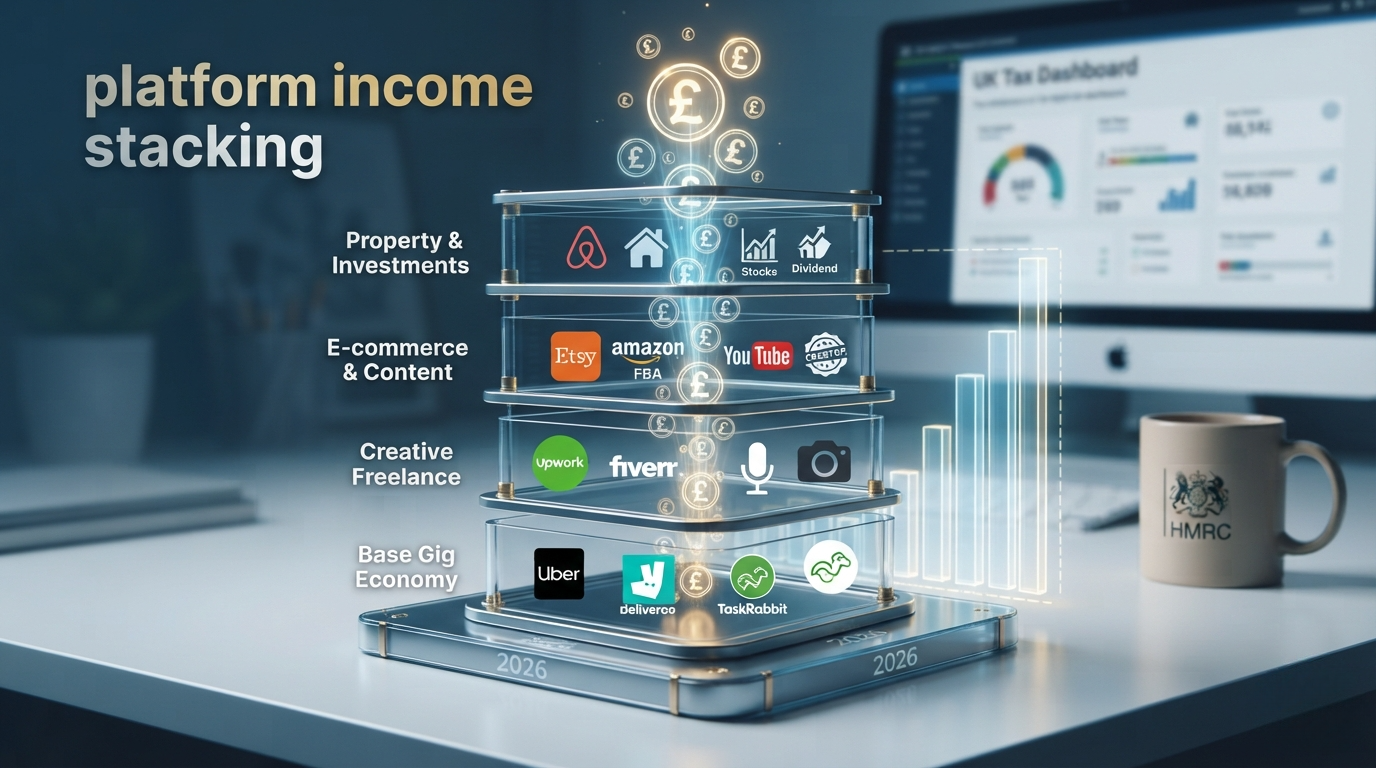
Platform income stacking means earning from several platforms at the same time: ride and delivery apps, freelance marketplaces, creator platforms and online shops, often alongside a job. Each platform is one layer of your stack. It spreads risk and raises the ceiling on what you can earn, but every layer takes its own cut and pays on its own schedule, so the total on your earnings screens is not the total you keep.
What Is Platform Income Stacking? The Modern Way of Working
For most of the last century, work had one shape. One employer. One payslip. One number, on one day, every month.
That shape is still around, but it's no longer the only one. More and more people earn from several platforms at once. They drive for two apps and deliver for a third. They freelance on two marketplaces. They're paid by a video platform, a membership platform and a shop, sometimes on top of a job and sometimes instead of one.
We call it platform income stacking, and we think it's the modern way of working. It isn't a side project or a phase. For a growing number of people it's simply how work is done.
The numbers back this up. When we brought together World Bank, ILO and national statistics for our research on the modern way of working, one pattern stood out: most people who earn from platforms aren't replacing a job, they're adding to one. 51% of US gig workers also have a main job that isn't gig work. The World Bank estimates up to 435 million people do online gig work, and only 132.5 million of them do it as their main work. Platform income is stacked, not switched to.
This post opens a six-part series about it. It covers what platform income stacking is, who does it, why it's growing, and the one number it hides.
What platform income stacking is
Platform income stacking means earning from more than one platform at the same time.
Each platform is one layer of your stack. Uber and Lyft. Upwork and Fiverr. Etsy and your own shop. YouTube, TikTok and Patreon. Two layers or seven, the idea is the same: no single platform carries all of your income.
It's different from having a job, and not only because there's more than one source. A job pays a known amount on a known day, with the deductions already worked out. A platform pays whatever it pays, after whatever it takes, whenever it pays out. Stack several and you have several sets of rules running at once.
The three shapes a stack takes
Look at how people actually stack platforms and three patterns come up again and again.
Same work, more platforms. A driver on two ride apps and a delivery app. A freelancer on two marketplaces. The skill is the same; the extra platforms mean fewer quiet hours.
Different work, different platforms. Design work on one platform, templates sold on another, a channel on a third. Each layer does a different job. We looked at this shape in the $100k platform earner: active work that pays now, an audience that builds reach, and a product that sells without your time.
A job plus platforms. A salary underneath, platform income on top. This is the most common stack of all, and it has its own complications, which we covered for the US and the UK.
Why more people work this way
The reasons people stack platforms are good ones, and they aren't going away.
One source can disappear. A platform changes its fees, its algorithm or its terms, or suspends an account. Someone on a single platform loses everything at once. A stack loses one layer.
Platforms fill different gaps. A quiet week on one app is often a busy week on another. Freelance work pays now; a product pays later.
The ceiling is higher. Hours on one platform run out. A stack can grow in more than one direction.
It works from anywhere. A stack can be built in Lagos, Leeds or Los Angeles, paid in several currencies, from customers who never meet you.
None of that is in doubt. What's been missing is a clear view of what happens to the money once the stack exists.
Why it skews young, and why it will grow
Platform income stacking is younger than traditional work. Most online gig workers are under 30, according to the World Bank. In the US, 30% of 18–29-year-olds have earned money through a gig platform, against 18% of 30–49-year-olds (Pew Research Center). It doesn't stop at 30, though. In Europe, people aged 30–64 make up about 7 in 10 platform workers (Eurostat). It starts young and carries on into mid-career.
Our reading of the research is that three things are pushing in the same direction.
The job market doesn't favour young people. Worldwide, 12.4% of 15–24-year-olds are unemployed, against 3.6% of adults (ILO, 2026). In low-income countries, most people already work for themselves because there aren't enough wage jobs.
Platforms make it easier to start. The World Bank finds that online gig platforms "tend to attract youth", mostly students and young professionals at the start of their careers, and that local platforms lower the barriers to entry (World Bank, 2023).
AI is squeezing first jobs. The ILO notes growing concern about the impact of AI on young workers, "particularly those seeking their first job" (ILO, 2026).
None of these sources says any one of these causes platform work on its own. Put together, though, we expect platform income stacking to grow, and to start earlier in people's working lives. The full figures, with sources, are in our modern way of working research.
What every layer does to the money
The old system was built around the payslip: one employer and one set of deductions, worked out for you. Platform income stacking breaks all of that, in three ways.
Every layer takes its own cut, in its own way. As worked examples checked in September 2026: YouTube keeps 45% of long-form ad revenue, Upwork charges a variable 0–15% per contract, Etsy stacks several fees that can reach around a quarter of an order, and Uber's fees typically take 25–30% of gross fares. For what each charges today, see YouTube, Upwork, Etsy and Uber.
Every layer pays on its own schedule. Weekly, fortnightly, monthly, after a hold, sometimes in a different currency.
Some costs belong to the whole stack. The car that drives for both apps, the laptop that does every job, the software, the phone. No single platform carries these, so no platform's figures include them.
So you end up with three or four earnings screens. Each one is accurate about itself, and none of them is your income.
The number nobody adds up
Picture a month like this. Uber shows $1,900. YouTube shows $1,200. Upwork shows $900. Etsy shows $800.
That's $4,800 on the screens. It's also why so many people with a stack feel they earned more than their bank account suggests. The screens show before-fees figures, or after-fees figures with the costs still to come, or money that won't land until next month.
The number that matters is the one none of the platforms shows you: what your whole stack kept this month, after every cut and every cost.
That's what this series is about. It isn't hard to find once you know where to look. No platform has a reason to show it to you, so you have to put it together yourself.
The Platform Income Stacking series
Read in order, these posts take you from "I earn from several platforms" to knowing exactly what your stack is worth:
- What is platform income stacking? You're here.
- How much does a platform income stack actually make? How to work out your real figure instead of guessing from the screens.
- Every layer takes a cut: what platform fees do to a stack.
- Five numbers to know when you stack platform income
- Should you add another platform to your stack?
- How to track a platform income stack when every platform pays differently
Start with one number
Before you read the rest, do one thing. Take last month's figure from your biggest platform and put it through the take-home pay calculator.
What comes out is that layer's real contribution to your stack. Do the same for the next layer and you've made a start on the one sum that tells you what your stack is worth.
Frequently Asked Questions
Work this out for yourself
Mason O.
FCCA FellowFounder, PlatformTaxHub | Author of the Platform Transparency Series
I help multi-platform earners know what they're actually keeping — through the Platform Transparency Series, the weekly Platform Income Stack newsletter, the PIOS framework, and PlatformTaxHub, the SaaS operating system that runs it. FCCA Finance Transformation Expert, two decades in FTSE 250 global companies.
👉 Get your free Platform Earnings Health Check