Table of Contents
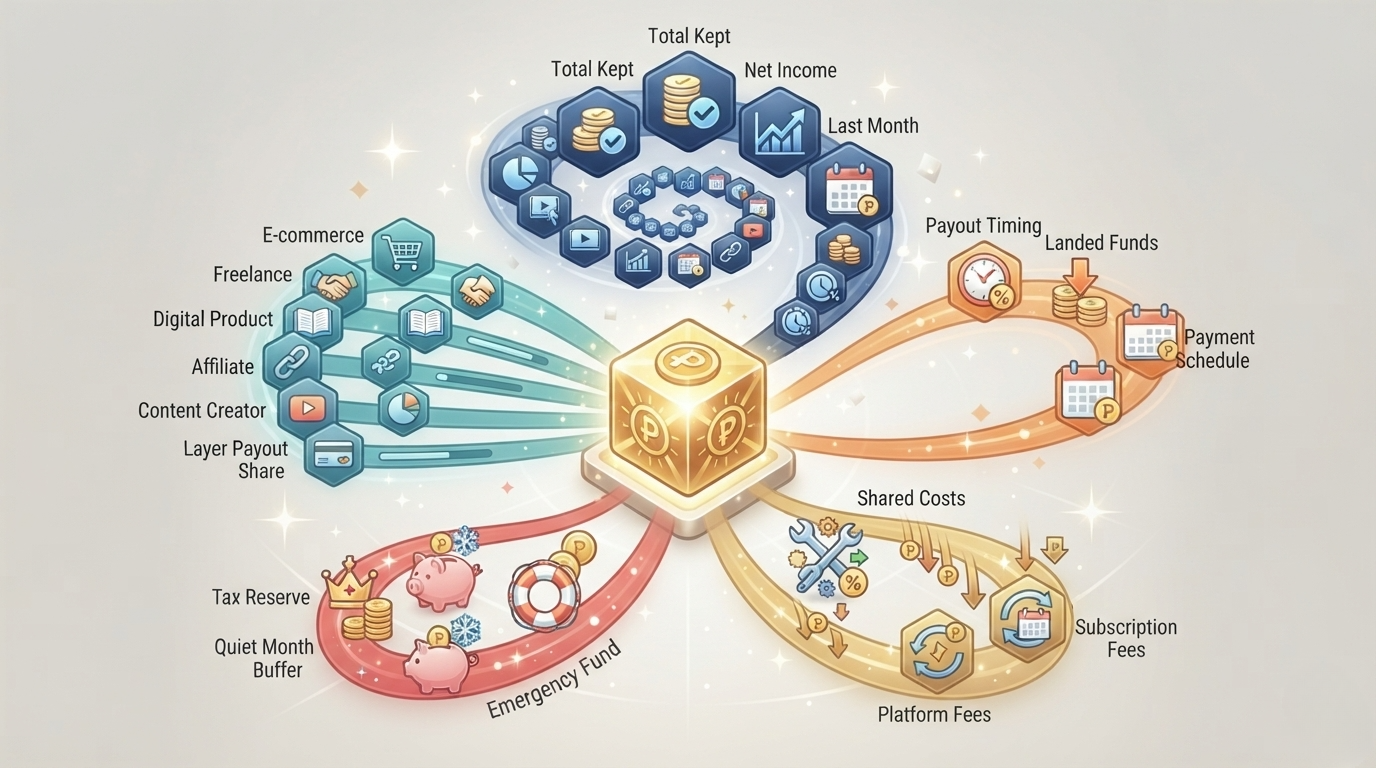
The five numbers are: what your whole stack kept last month after fees and costs; what each layer kept on its own; when each platform's money actually lands; how much you have set aside for tax and quiet months; and what your stack costs to run in fees and shared costs. With those five, you can answer "how am I actually doing?" in under a minute.
Five Numbers to Know When You Stack Platform Income
Ask someone who stacks platform income how their month went and you'll often get a pause, then a guess.
It's not because they're disorganised. It's because the answer is spread across four apps, three payout schedules and a bank account that mixes last week's money with this week's. The information exists. It just isn't in one place.
You don't need a finance degree to get it into one place. You need five numbers. Know these and "how am I actually doing?" takes a minute to answer.
This post is part of the Platform Income Stacking series.
1. What your stack kept last month
The whole stack, after every platform's cut and every shared cost. Not the total across your earnings screens, and not your bank balance.
This is the number you can actually spend, and it's the one most people with a stack have never seen written down. How much does a platform income stack actually make? walks through working it out in four steps.
Clear when: you can say it without opening an app.
2. What each layer kept
The same figure, layer by layer. How much did the ride app keep you? The freelance platform? The shop?
This is the number that tells you where your stack is strong and where it's leaking. Layers with similar gross can keep very different amounts, because each platform charges differently. Every layer takes a cut explains why.
Clear when: you know which layer keeps the most per hour of your time, and which keeps the least.
3. When the money actually lands
Every platform pays on its own clock: weekly, fortnightly, monthly, after a hold, with a charge for instant payout. So a stack's income arrives in lumps that don't line up with the work.
Knowing the dates in advance is what lets you pay bills on time from uneven income. The payout calendar shows when each platform pays, and paying yourself a steady amount shows how to turn lumpy payouts into a regular amount.
Clear when: you could say which platforms pay next week, and roughly how much.
4. What you've set aside
Most platform income arrives with nothing taken off for tax. Platforms also don't give you the paid leave, sick pay and pension an employer would provide.
So you need one figure: how much is set aside right now, and whether it covers what you'll owe and a quiet month. Tax rules depend on where you live, so the rate is yours to check, but the habit is the same everywhere. The benefits safety net calculator helps you size the non-tax part.
Clear when: a large payout lands and you know straight away how much of it isn't yours to spend.
5. What your stack costs to run
Two parts: what platforms took in fees across all layers, and the shared costs underneath them (vehicle, equipment, software, phone).
As a percentage of your gross, this is your stack's running cost. It's the number that tells you whether a busy month was a good one, and whether adding another platform is likely to help. The platform fee comparison is the quickest way to see the fee part.
Clear when: you could say "my stack costs me about X% to run" and be close.
One page, once a month
Write the five numbers on one page at the start of each month:
| Number | Last month |
|---|---|
| What the stack kept | |
| What each layer kept | |
| Payouts due this month (dates) | |
| Set aside | |
| Stack running cost (%) |
That's it. Twenty minutes the first time, ten after that.
It won't make your stack earn more on its own. What it does is give you clarity, and that's what you need to decide what to do next: which layer to put more time into, what to charge, whether to add a platform or drop one.
Next in the series: should you add another platform to your stack?
Frequently Asked Questions
Work this out for yourself
Mason O.
FCCA FellowFounder, PlatformTaxHub | Author of the Platform Transparency Series
I help multi-platform earners know what they're actually keeping — through the Platform Transparency Series, the weekly Platform Income Stack newsletter, the PIOS framework, and PlatformTaxHub, the SaaS operating system that runs it. FCCA Finance Transformation Expert, two decades in FTSE 250 global companies.
👉 Get your free Platform Earnings Health Check