Table of Contents
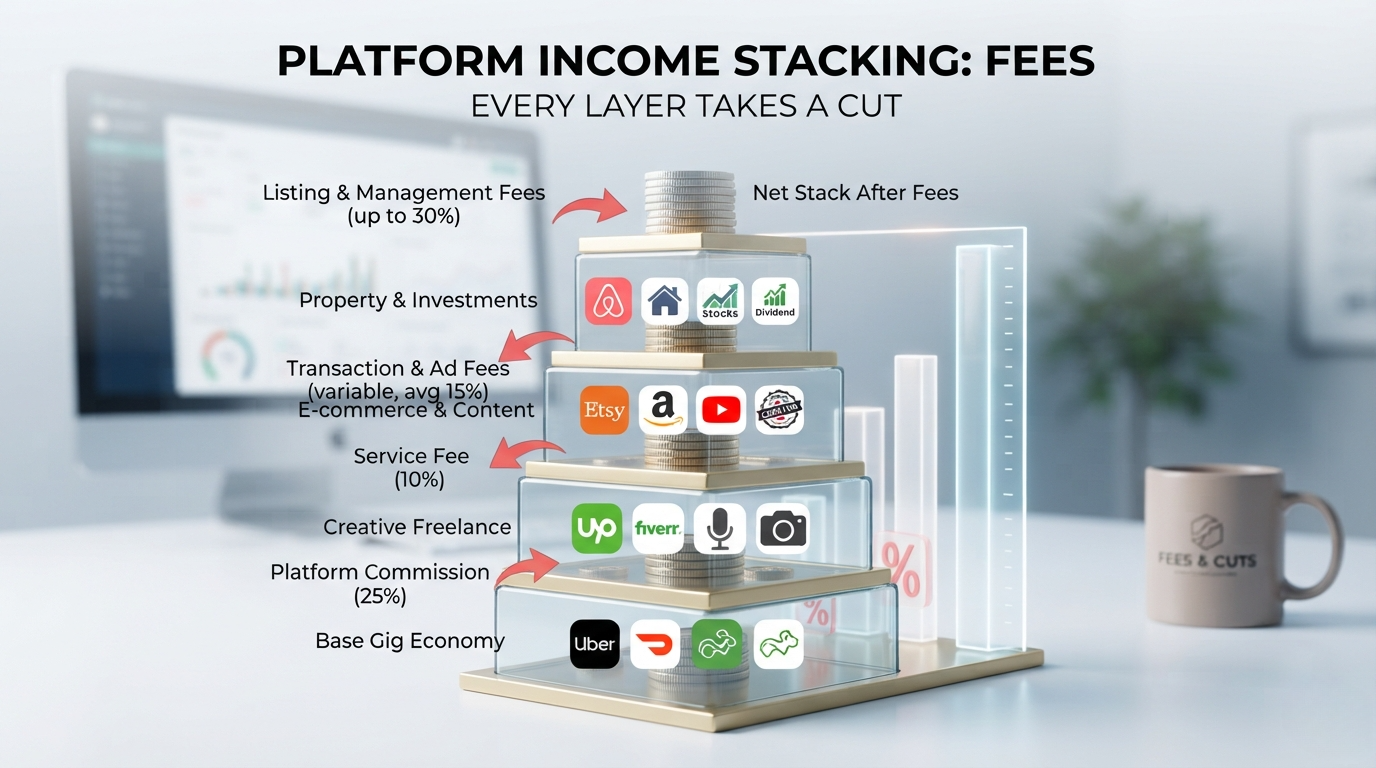
Every platform in a platform income stack takes its cut in its own way: a percentage of each sale, a revenue split, per-item fees, payment processing, currency conversion or a charge to withdraw. Because each layer charges differently, your stack has an overall fee rate that no platform shows you. You find it by taking each layer's fees off that layer's gross and comparing the total kept with the total earned.
Every Layer Takes a Cut: What Fees Do to Your Platform Income Stack
Platform fees change without notice. The figures here were checked in September 2026 and are worked examples, not current rates. For what a platform charges today, see YouTube, Upwork, Etsy, Uber and Gumroad.
When you stack platform income, you stack the platforms' fees too.
That's not a reason not to stack. It's a reason to know what each layer costs, because the fees are where a stack's real result gets decided, and they're the part hardest to see from the inside.
This post is part of the Platform Income Stacking series.
Five ways a layer takes its cut
Platforms don't all charge the same way, and that's the first problem. A stack is usually a mix of these:
A percentage of each job or sale. The freelance marketplace model. Upwork charges a variable 0–15% per contract, set when the contract starts.
A revenue split. The creator model. YouTube pays creators 55% of long-form ad revenue and keeps 45%. You never see the 45%. You see what's left.
Several fees at once. The marketplace seller model. Etsy's 6.5% transaction fee is one of at least four charges; with payment processing, listing fees and Offsite Ads, one sale can lose around a quarter of its value.
Service and booking fees on each trip. The gig model. Uber's fees typically take 25–30% of gross fares before the driver's share is shown.
A different rate depending on who found the customer. Gumroad takes 10% on sales from your own traffic and 30% on sales from its Discover marketplace. Same product, same price, very different amount kept.
Then, sitting on top of any of these: payment processing, currency conversion, instant-payout charges and withdrawal fees.
Why your stack's real fee rate is hidden
Each platform tells you its own rate, more or less. None of them tells you what your stack pays in fees overall, because none of them knows the rest of your stack exists.
So the figure that matters, the share of everything you earned that went to platforms, has to be worked out by you. It's almost always higher than the headline rate of any single platform you use, because the small extra charges on each layer add up.
It's also different from month to month, because the mix changes. A month heavy on your 10% layer and light on your 45% layer keeps a lot more of the same gross than the reverse.
A stack, layer by layer
Worked example, round numbers, using the September 2026 rates above:
| Layer | Gross | Fee model | Kept |
|---|---|---|---|
| Video ad revenue | $2,000 | 45% revenue share | $1,100 |
| Freelance contracts | $1,500 | 10% contract fee | $1,350 |
| Digital product, own traffic | $600 | 10% | $540 |
| Digital product, marketplace sales | $400 | 30% | $280 |
| Stack | $4,500 | $3,270 |
That stack paid $1,230 in platform fees, about 27% of everything it earned, before any processing, currency or withdrawal charges. None of its platforms charges 27%. The stack does.
What changes when you see it layer by layer
You find the expensive layer. Often it's not the one you'd guess. A layer with a high headline rate but no extra charges can keep more than one with a low rate and four add-ons.
You see the mix effect. Shifting a few hours or a few sales from your most expensive layer to your cheapest changes what the whole stack keeps, without earning a cent more gross.
You stop pricing from the screen. If a layer keeps 55% of what the customer pays, your price on that layer has to allow for it.
How to see your own
- For each layer, find one month's gross and what actually arrived.
- The difference is that layer's cost to you. Note what it's made of, where the platform shows it.
- Add up the differences across all layers and divide by your total gross. That's your stack's fee rate.
The platform fee comparison shows how the platforms you use compare side by side, and there are head-to-head versions for common stacks such as Upwork and Fiverr, Uber and Lyft and YouTube and TikTok. For single platforms in depth: YouTube, Upwork, Uber, Etsy, Airbnb and Gumroad.
The takeaway
Your stack has a fee rate. No platform will tell you what it is, but once you've worked it out you can see which layer is costing you most, and whether the next platform you're thinking about adding will leave you better off.
Next in the series: five numbers to know when you stack platform income.
Frequently Asked Questions
Work this out for yourself
Mason O.
FCCA FellowFounder, PlatformTaxHub | Author of the Platform Transparency Series
I help multi-platform earners know what they're actually keeping — through the Platform Transparency Series, the weekly Platform Income Stack newsletter, the PIOS framework, and PlatformTaxHub, the SaaS operating system that runs it. FCCA Finance Transformation Expert, two decades in FTSE 250 global companies.
👉 Get your free Platform Earnings Health Check