Table of Contents
To track a platform income stack, record three things for every layer: the gross it earned, the fees it took, and when the money actually arrived. Keep everything in one place, converted to the currency you live in, alongside the costs your whole stack shares. Once a month, total it up to see what the stack kept. When you have more than two or three layers, or more than one currency, a spreadsheet usually stops keeping up.
How to Track a Platform Income Stack When Every Platform Pays Differently
Tracking one income is simple. A payslip arrives, the number is on it, done.
Tracking a platform income stack isn't that job done four times. Every platform reports its earnings differently, charges its fees differently and pays out on a different day, sometimes in a different currency. Four earnings screens don't add up to one clear picture unless something puts them together.
This is the last post in the Platform Income Stacking series. The earlier posts showed what to look for. This one is about keeping it in one place, every month, without it taking over your evenings.
Three things to record for every layer
For each platform, each month:
1. Gross. What the customer paid, before the platform took anything. If the platform only shows net, work backwards with the platform fee calculator.
2. Fees. What the platform kept, recorded as its own line. Don't bury it in a net figure. The fee is part of your real result, it's the number that shows which layer is expensive, and in many countries it's a cost you can claim.
3. When it landed. The date the money actually reached you, and the amount that arrived. This is what lets you tell the difference between a bad month and a late payout.
That's the whole record for each layer: three figures for every payout.
Two things to record for the whole stack
Shared costs. The vehicle, equipment, software, phone and internet that every layer uses. Record them once, for the stack, not split across platforms.
One currency. Convert everything to the currency you live in, at the rate you actually received. If you record each layer in its own currency, you can't add them up, and what the conversions cost you gets lost.
A monthly routine
As payouts land: add each one with its gross, fee and date. A few minutes each.
Start of the month: total the stack. Gross across all layers, fees across all layers, shared costs, and what's left. That last figure is what your stack kept, the first of the five numbers to know when you stack platform income.
Once a quarter: look at each layer's share. Which one keeps the most per hour? Which one's fees have crept up? Is it time to add a platform, or drop one?
Where spreadsheets stop keeping up
A spreadsheet works for a small stack. Two layers, one currency, platforms whose exports you understand.
It gets harder with each layer you add, for reasons that have nothing to do with how organised you are:
- Every platform's export has different columns, different date formats and different ways of showing fees.
- Some report gross, some net, some both, and some split fees across several lines.
- Several currencies mean a conversion for every row, at the rate you actually got.
- Payout reports and your bank statement never quite match, because of holds, batching and transfer fees.
We went through this in more detail in the spreadsheet trap. The short version: the spreadsheet doesn't break all at once. It gets slower, gets skipped a month, and stops being trusted.
What a stack tracker should do
Whatever you use, it should:
- Take each platform's payout report as it comes, or let you add entries by hand.
- Keep gross, fees and net separate, per platform.
- Convert every layer to your home currency.
- Hold the shared costs alongside the income.
- Show you the whole stack and each layer in one view.
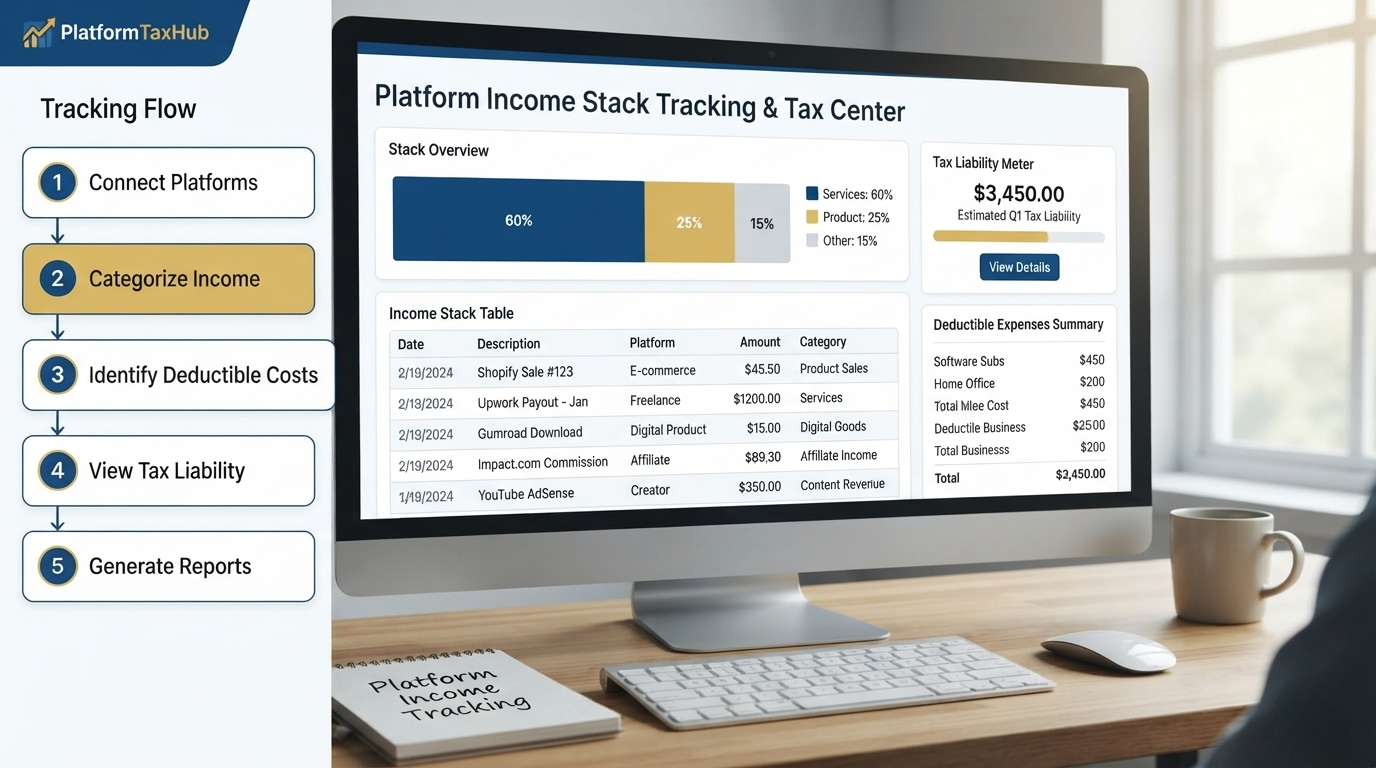
That's what the PlatformTaxHub income tracker is built to do. You upload the CSVs from your platforms or enter transactions yourself, it sorts income and expenses and converts currencies, and it shows your total across every platform in your home currency: gross, fees and what you actually keep. Tracking works wherever you live.
The point of all this
Tracking isn't the goal. Clarity is.
A stack that's tracked this way answers the questions that matter: what did I keep, which layer is working, when is the next money coming, is it time to change something. A stack that isn't tracked answers them with a guess.
If you've read the series in order, you now know what platform income stacking is, what your stack makes, what each layer costs, the five numbers to watch, and how to decide on the next platform. This is the last step: keeping it all in one place, so the answers are there when you need them.
Start with the free tools. Put each layer through the take-home pay calculator, then bring the whole stack into the income tracker.
Frequently Asked Questions
Work this out for yourself
Mason O.
FCCA FellowFounder, PlatformTaxHub | Author of the Platform Transparency Series
I help multi-platform earners know what they're actually keeping — through the Platform Transparency Series, the weekly Platform Income Stack newsletter, the PIOS framework, and PlatformTaxHub, the SaaS operating system that runs it. FCCA Finance Transformation Expert, two decades in FTSE 250 global companies.
👉 Get your free Platform Earnings Health Check