Table of Contents
Paying yourself a steady amount from irregular platform income works by separating business money from personal money, setting aside what you owe in tax as each payment arrives, then paying yourself a fixed monthly amount based on a rolling average of net profit rather than on last month. Paying yourself less than the average is deliberate: the surplus is what covers the months that come in under it.
How to Pay Yourself a Steady Amount From Unpredictable Platform Income
Tax rates and thresholds change every tax year. The 2026 figures referenced here were checked in September 2026; for the current position see IRS self-employment tax and gov.uk income tax. General information, not advice on your own return.
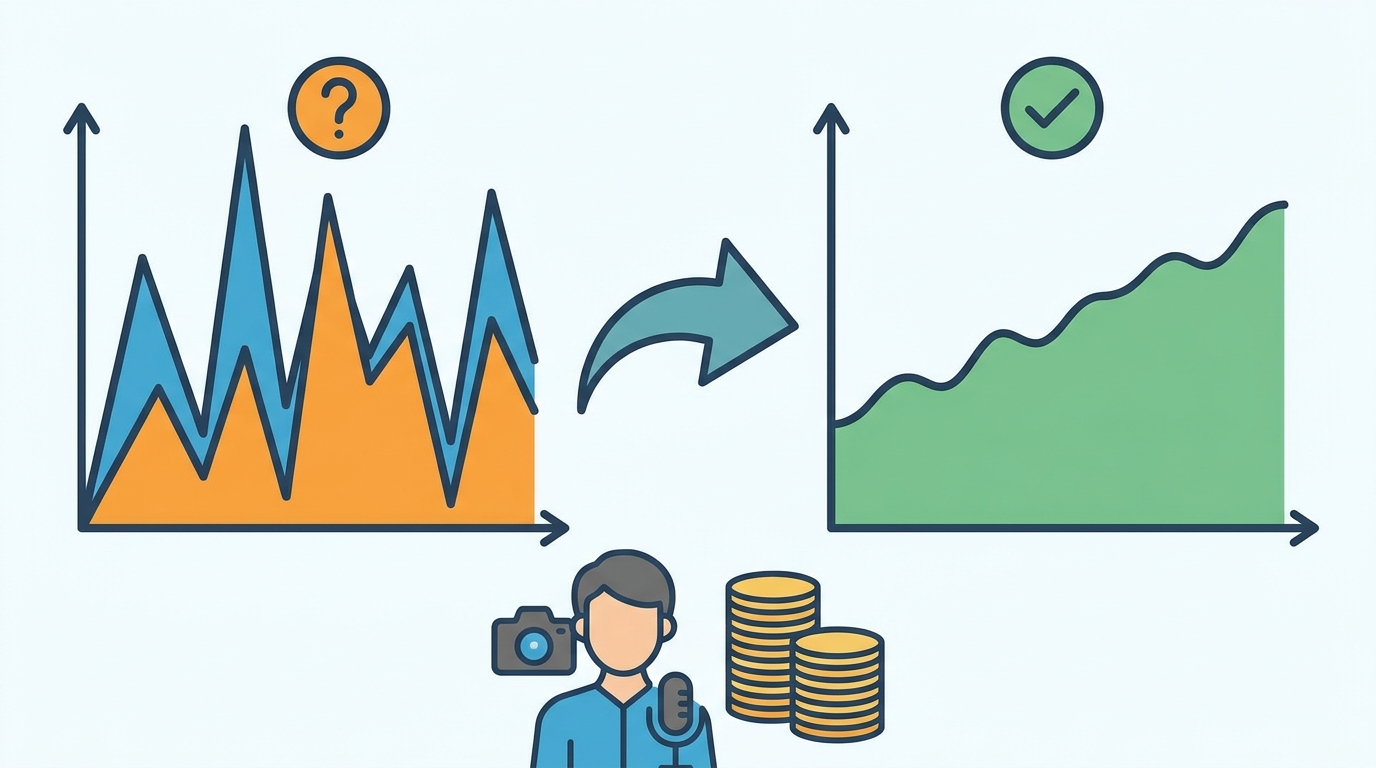
A big month is not a good month. An £8,000 month followed by a £1,500 month is not success, it is a cash flow problem that has not arrived yet.
You overspend in the good months because the money feels abundant. You panic in the quiet ones because the bills did not get the memo. Most advice about this tells you to earn more, which misses the point entirely. The income is not the problem. The way it flows into your life is.
The mistake is treating business money as personal money
When a £3,000 payment from Upwork lands, most platform earners pay rent from it, buy groceries from it and order a microphone from it. All from the same pool.
That £3,000 is not your pay. It is revenue. Inside it are the fees already taken, the tax you will owe, the business costs you have not paid yet, and somewhere underneath all of that, the part that is genuinely yours to live on. Spending from the top of it means spending money that has already been committed to something else.
The fix is separation, and the mechanism is duller than most people expect. Three places money can sit, and rules about which direction it moves.
Three places, three jobs
Where income lands. Every payment from every platform arrives here first, gross. This is the business, and nothing personal is ever paid from it directly.
Where tax waits. The moment money arrives, the portion you will owe moves out of reach. This is not an emergency fund and not a buffer. It has one job and it is already spoken for.
Where you live from. A fixed amount arrives here on the same day each month, and your rent, food and everything else comes out of it. This account never sees a platform payment.
The discipline is that money only crosses those boundaries on schedule. Not when a big payment lands, not when something looks affordable.
Working out what you can actually pay yourself
Start with profit, not with what arrived. Gross income, minus platform fees, minus business costs, minus what you owe in tax. That last figure is the one people guess at, and guessing is where this comes apart. The online earnings calculator will give you a figure based on your country, income and structure rather than a rule of thumb that may not describe you at all.
For how the first part of that sum works, the gross versus net guide covers where the gap between the two comes from.
Then average it. Your income is volatile, so a single month tells you nothing about what you can sustain. Take the average monthly net profit over three months, or six if you want it steadier. Six smooths harder. Three responds faster when the business grows.
Say three months come in at £4,000, £1,500 and £5,000. The average is £3,500. That is the number the decision is built on, not the £5,000 you remember most fondly.
Then pay yourself less than that. This is the part people resist and it is the part that makes it work. If the average is £3,500, paying yourself somewhere around £2,800 leaves the remainder in the business.
That remainder is not caution for its own sake. It is what covers the month that comes in at £1,500.
The leftover is the point
Because you are paying yourself under the average, the business account builds up. That surplus is doing a job.
The first job is covering a bad month without changing anything. Enough to keep paying yourself and your fixed business costs through a stretch where income stalls, so that a quiet month is an accounting event rather than a crisis.
Once that is there, the surplus becomes optional money. Equipment, a course, a quarter where you take something extra out. The difference is that it is now a decision rather than a reaction.
The monthly rhythm
As payments arrive, they land in the business and the tax portion immediately moves out of reach. On the same date every month, the fixed amount moves to your personal account and business costs are paid from the business.
Every quarter, recalculate the rolling average and adjust what you pay yourself. That is how the amount grows as the business does, without whipping around every time a big invoice clears.
What actually changes
This is not budgeting advice with extra steps. It changes what you are reacting to.
Right now your personal finances move with your worst client, your slowest platform and the month your payouts happened to land. After this they move once a quarter, on a number you calculated, from a business that has been separated out and capitalised enough to absorb the variation.
The volatility does not go away. It stops reaching you.
Frequently Asked Questions
Work this out for yourself
Mason
FCCA FellowFounder, PlatformTaxHub | Author of the Platform Transparency Series
I help multi-platform earners find the income their dashboards are hiding — and keep more of what they actually make. Fellow of Certified Accountants and former Finance Transformation specialist with decades of experience across FTSE 250 and global organisations. PlatformTaxHub was built after experiencing the platform income problem firsthand and seeing what tax authorities have planned for the earners who aren't ready.
👉 Get your free Platform Earnings Health Check