Table of Contents
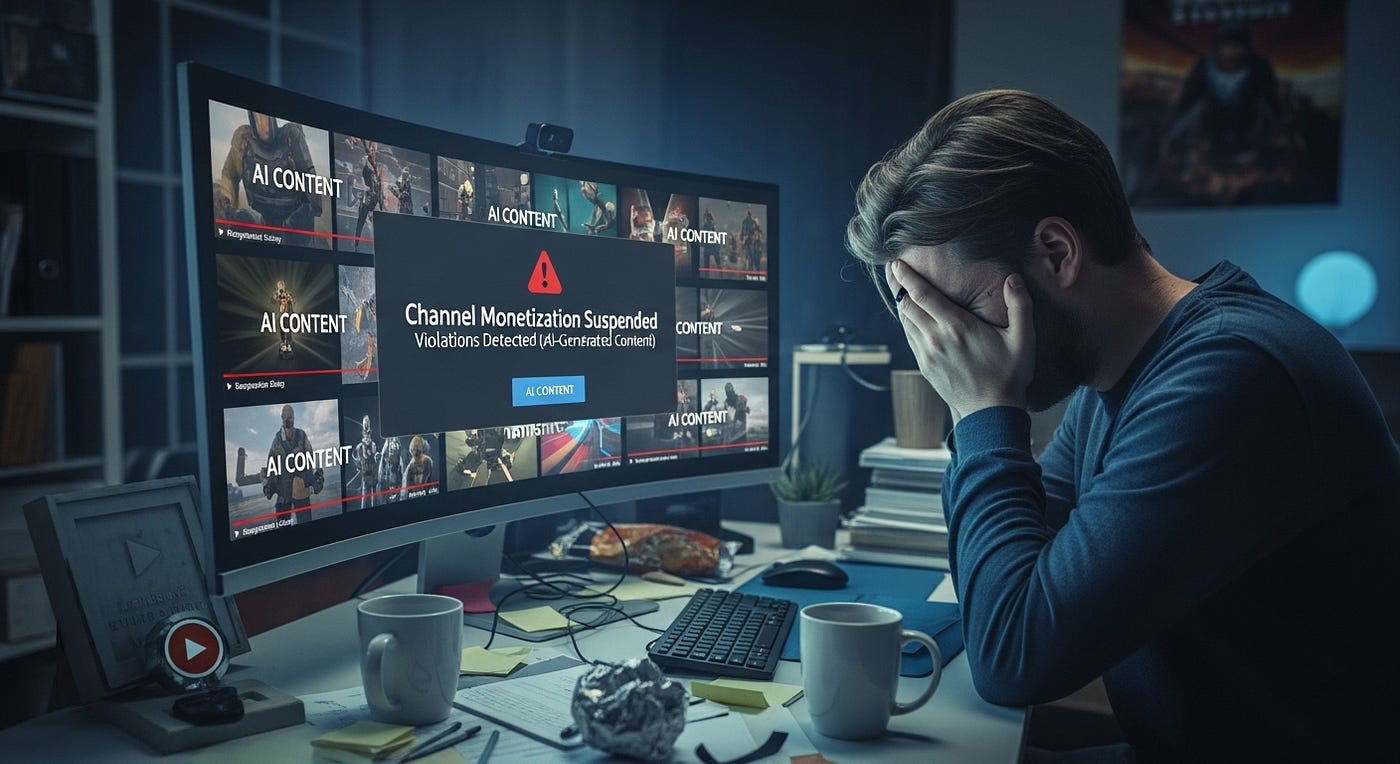
In 2026, platforms are using aggressive AI detection to remove low-quality "slop." Automated moderation at that scale catches legitimate creators alongside the target, with little explanation and often no appeal. The only defense is diversification and understanding your financial baseline so that a platform shutdown doesn't destroy your business.
The AI Trained to Fight AI Slop is Catching Real Creators. Could You Be Next?
AI has become a financial noose the platform/creator economy is trapped in.
⚡ The 30-Second Summary:
- The Problem: Platforms are using AI to police AI slop — and it is catching real creators in the dragnet.
- The Risk: False positives are destroying income overnight with no warning, no explanation, and no meaningful appeal.
- The Reality: You cannot stop it. But you can control your financial baseline so when it happens, it does not destroy you.
So I noticed an increasing rise in something alarming.
Demonetisations. Account closures. Shadow bans.
And I'm not talking about small accounts or people violating guidelines. I'm talking about creators with millions of followers. Accounts that have been someone's main source of income for years.
One day… overnight… accounts are demonetised. Some are closed entirely.
No warning. No explanation. No human to talk to. No lifeline. No safety net.
1. The Major Culprits
YouTube
YouTube has been the most aggressive. Through late 2025 and early 2026 there were widespread reports of channels being banned, demonetised or closed. I have not found a figure for the scale of it that I can stand behind, and the numbers circulating are not sourced to YouTube.
YouTube rolled out enhanced AI content detection. The goal was to identify and remove AI-generated content that violates their authenticity policies. Sounds reasonable, right? Except here is what is happening.
Creators who have been on the platform for 10+ years, creating original content, using AI automation to make their lives easier, are suddenly flagged. Their entire channels demonetised.
One bible channel flagged for repetitive content. Demonetised. One cooking channel with a decade of authentic recipes got hit. The creator appealed. The AI denied it. No human ever reviewed the case. Another creator's voice was flagged as "synthetic" because they had an accent the AI was not trained on.
The pattern is becoming clear: YouTube's AI cannot distinguish between actual AI slop and real creators who just happen to trigger certain patterns.
Professional editors using AI-assisted colour grading? Flagged. Creators using stock footage or b-roll? Flagged. Non-native English speakers? Flagged.
The AI is trained to look for patterns. And it finds them everywhere — including in places where they do not mean what the AI thinks they mean. That is brutal.
TikTok
TikTok has taken a different approach but the results are similar.
They deploy AI to identify "inauthentic" accounts, bot networks flooding the platform with mass-produced content. The criteria made sense on paper: upload frequency, content similarity, engagement patterns, audio and visual consistency.
But then large newspaper outlets reporting news on a posting schedule. Flagged. Educators sharing consistent lesson formats. Flagged. Niche creators with recognizable visual styles. Flagged as "potential bots."
Some have lost access to TikTok Shop, their entire business. Others had accounts permanently banned. Appeals? Routed back to the same AI that flagged them in the first place.
Platforms defend automated moderation on its accuracy rate. The problem with that defence is the arithmetic of scale: on a platform with hundreds of millions of accounts, even a very small error rate produces a very large number of wrongly flagged people. I am not going to put a specific accuracy figure in any platform's mouth here, because I cannot source one — but the shape of the problem does not depend on the exact number. A rate that sounds like a rounding error at the company is not a rounding error to the creators inside it.
Instagram has been in stealth mode. No official announcements. No transparency reports. Just creators noticing their reach collapsing overnight.
Posts that normally get thousands of views suddenly get crickets. Stories disappear from followers' feeds. Hashtags stop working.
Creators call it shadowbanning. Platforms tend to describe reduced distribution in more neutral terms, and rarely confirm it as a deliberate action at all.
I discussed for 3 days with a friend of mine why I was not seeing her posts and if maybe she was doing something wrong. But no. It was Instagram's content hiding… sorry… content suppressing… sorry… ads prioritisation in the form of content.
Platforms generally do not confirm using automated systems to suppress reach, which is exactly what makes it hard to argue with. So Instagram's AI moderation is a difficult beast to pin down to AI moderation or algorithm changes. But which is worse — shadowbanning or your posts not being seen. There's no clear path back. No notification. No appeal process. No human review. Just silence.
2. Why is this happening?
Let's start with the AI slop problem.
AI is supposed to be a good thing. A tool to help creators work faster, edit better, produce more. And for many creators, it is.
But some individuals, let's be honest, a lot of individuals, started using AI to mass-produce low-quality content. So there are content farms churning out hundreds of videos per day on multiple channels with clickbait titles.
This is what's now known as AI slop. Even I recognise it having stumbled on it. And it's everywhere.
Even I don't want to see it, so yes, these platforms have to respond, and respond in a way that makes their work done faster with less effort. Because the volumes are massive. The scale too overwhelming.
So of course they have done what tech companies do: they built an AI to solve the problem another tech created. AI to police AI.
The logic makes sense. Use automation to catch automation at scale. Fight fire with fire. But then it falls apart.
3. The AI Can't Tell the Difference
The AI that platforms deployed to catch AI slop is trained on patterns or keywords: consistency in upload schedules, format, concepts; similar visual styles across videos; use of stock footage or templates; certain audio patterns.
The problem is: legitimate creators trigger these same patterns.
Educators post on consistent schedules. Brands maintain visual consistency. Businesses use templates because that is what organised people do — they build systems.
It is such an irony. AI was built on patterns, keywords and structure. But you as a creator are not allowed to build your own systems using the same methods without being flagged for it.
So when the AI scans for bot behavior, it catches real creators in the dragnet.
And here's what makes it worse: the AI has no context. It can't understand that your "repetitive content structure" is actually your teaching format. It can't see that your "similar thumbnails" are brand consistency. It can't tell that your "synthetic-sounding voice" is just your accent.
The AI just sees patterns. And patterns match. So you're flagged.
The appeals process (or lack of one)
So you have been flagged. You appeal. You get an immediate response and think that was fast — until you realise AI reviewed your appeal.
I remember a time I complained about a boss to HR and HR sent my complaint directly to the boss I complained about. You can imagine the outcome.
That is exactly what is happening here.
And even when you do get a human review, that human is looking at the same data the AI flagged. They are not re-evaluating from scratch. They are checking whether the AI followed its rules. If the AI flagged you according to its programming, the human approves the flag. Even if the flag was wrong.
Note: If you are in a situation where you would rather not face an appeal, get your house in order by using our free Online Earnings Calculator.
4. The Cost No One Counts
Now for platforms, false positives are a minor inconvenience. A statistical blip in their moderation reports. A better or predicted outcome.
For creators, it's devastating.
Lost income. Demonetized channels mean $0 revenue. Shadowbanned accounts see 80-90% reach drops. Banned TikTok Shops mean entire businesses gone overnight. I have seen reports of creators losing $5,000, $10,000, even $50,000 per month in income. Just gone.
Lost time. Hours filing appeals. Days waiting for responses. Weeks trying to rebuild reach. Months recovering revenue. Time they could have spent creating, building, growing — instead spent fighting an AI that does not understand context.
Lost trust. Audiences wonder what happened. Sponsors pull contracts. Collaborators distance themselves. Reputation takes a hit. Because even when creators get reinstated, the damage is done. People see the gap and fill the gap. They moved on.
Lost opportunity. While you are fighting to get your account back, your competitors are growing. The algorithm favors fresh, "inauthentic" active accounts. When you come back, you're starting at the back of the line.
And here's the cruelest part: the AI does not explain. The platform does not disclose. The appeal process is non-existent when it comes to telling you exactly why you were banned or demonetised.
5. Why Platforms Won't Fix This
You might think platforms would prioritize getting things right and going after the worst culprits instead. No. They won't. And here's why:
The economic calculation. From a platform's perspective: the cost of a false positive is one creator loses income — unfortunate, but replaceable. The cost of missing AI slop is advertisers leave, regulators intervene, platform reputation suffers. It's safer for platforms to flag 1,000 innocent creators than to miss one major advertiser. Creators are expendable. Everyone wants to be a creator of some sort. Advertisers are not expendable.
The scale problem. Even if platforms want to implement better human review, they cannot. YouTube: 500 hours of video uploaded every minute. TikTok: millions of videos daily. Instagram: billions of posts. There's no way to manually review everything. Even with thousands of human moderators, platforms can't keep up. So they optimize the AI for one thing: catch as much AI slop as possible, even if it means catching legitimate creators too. This is what happens with tax authorities — they send a demand notice and you have to file an appeal.
The supply-side reality. Platforms have an infinite supply of creators. For every creator who leaves after being wrongly flagged, ten more join. For every account that gets banned, twenty new accounts are created. Individual creators have no leverage. The platform doesn't need you specifically. It needs content. And content is abundant.
So the economic incentive isn't to protect individual creators. It's to protect the ecosystem: advertisers, regulators, and the platform's reputation. You are collateral damage in that equation.
6. What This Means for Platform Earners in 2026
If you earn income from platforms, this should concern you.
The new reality: your income can disappear overnight. And you'll have limited recourse.
You face the compounding risk. With every new AI system a platform deploys, they are deploying their AI detection for: copyright claims, community guideline enforcement, spam, fraud prevention, age verification, "inauthentic" content.
Every new AI detection system is another potential false positive. Every algorithm update is another roll of the dice. Every new enforcement layer is another potential false positive.
And as platforms add more AI moderation, the risk compounds. You are building a business on infrastructure you do not control, governed by systems you cannot see, reviewed by AI you cannot meaningfully appeal to. That is not a stable foundation. That is a gamble.
7. So What Do You Do?
Begin to build and own
Every piece of content you produce must belong to you. Use platforms to lease space and position your content, not as the foundation your business sits on. Platforms like Beehiiv, and not Reddit (that is a post for another day). Platforms like YouTube, even though they are on this list.
Diversify
Do not build your entire income on one platform.
If Instagram is your main source, build on YouTube and your own website. If TikTok Shop is your business, have a Gumroad store as backup. If YouTube is your audience, capture emails so you own the relationship. Where you diversify to is a real decision rather than a coin toss — YouTube and TikTok compared on intent versus attention is the argument for picking the second platform on what it can be built on rather than on reach.
One platform going down should not destroy your entire business.
Understand your financial baseline
When platform income is volatile, and it is, you need to know your real numbers. Not what the platform says you earned. Not your gross revenue.
Your actual take-home after: platform fees, payment processing fees, currency conversion (if you're earning across borders), taxes.
Because when your income drops 80% overnight, you need to know: what's your baseline to survive? How long can you last? What do you actually owe in taxes even with reduced income?
That clarity is your shield. The creators guide sets out the components of that baseline — what each revenue share leaves, which costs are claimable against it, and how the picture differs by region.
The faster you know what each platform actually pays you, the better you survive one of them turning off. That means: knowing what you're losing to hidden fees, optimizing your tax strategy, understanding your deductions, keeping more of what you earn.
Every dollar you save is a dollar in your own wallet — for better financial protection and more options. Every finance/tax strategy you optimize is breathing room when income drops.
Stay aware. Know the risks. So prepare for it. Plan for it. Build like it's inevitable. Because from 2026, it might be.
Final Thought
The future of platforms isn't about letting creators churn out content indiscriminately. It will be about quality over quantity.
In 2026, ask yourself: "If I got demonetised right now, am I financially safe?" "What leverage do I actually have with the platforms I use?"
Because platforms reward people with leverage. And the answer to that second question will tell you more about your business than any revenue number.
Conclusion
Platform income is unpredictable — it is not guaranteed, neither is a job. But most creators only discover that the day it disappears.
Platforms will keep optimising for advertisers. The AI will keep flagging at scale. You cannot change any of that.
What you can change is your financial foundation, by knowing your real numbers, owning your content, and building your Finance Operating System buffer.
Because when the algorithm comes for your income — and the evidence says it will — the only thing standing between you and zero is the infrastructural options you have built.
When platform income is unpredictable, your financial foundation should not be.
P.S. Stop the Friction in Your Own Finances
I'm building PlatformTaxHub to solve the same friction I wrote about today — specifically the nightmare of tracking multi-platform, multi-currency earnings. If you're tired of the spreadsheet chaos, tracking income volatility, or underestimating your taxes, use our resources to take back control:
- Track Your Income: See what's actually hitting your pocket with the Income Tracker.
- Extrapolate Your Net Profit: Normalise irregular independent-worker income with Net Profit & Financial Insights.
- Know Where You Stand Before You File: The Tax & Compliance Suite produces a tax estimate and a filing-readiness checklist so you go into your return prepared. It does not file anything for you.
- Scale Your Brand/Business: Use the Platform AI Growth Engine to personalise your earnings growth.
Don't let platforms treat you like paperwork. Start treating your platform work like a business.
The Platform Transparency Series
This is one of nine pieces that go inside the platforms people earn from. The full series, and how it fits with our research, is at The Platform Transparency Series.
- How Much Does YouTube Actually Pay? The Fee Layers Between AdSense and Your Bank Account
- How Much Does Upwork Take? What Freelancers Really Keep After Fees, Connects and VAT
- How Much Does Uber Take From Drivers? Gross Fares, Fees and What You Actually Keep
- How Much Does Etsy Take? The Full Fee Stack Eating Seller Margins
- How Much Does Airbnb Take From Hosts? Fees, Pass-Throughs and What You Actually Keep
- How Much Does Gumroad Take? The 10% Fee, the 30% Discover Rate and What Reaches You
- The Platform Friction Crisis
- YouTube (Intent Economy) vs TikTok (Attention Economy): Which Game Are You Playing?
Frequently Asked Questions
Work this out for yourself
Mason O.
FCCA FellowFounder, PlatformTaxHub | Author of the Platform Transparency Series
I help multi-platform earners know what they're actually keeping — through the Platform Transparency Series, the weekly Platform Income Stack newsletter, the PIOS framework, and PlatformTaxHub, the SaaS operating system that runs it. FCCA Finance Transformation Expert, two decades in FTSE 250 global companies.
👉 Get your free Platform Earnings Health Check