Table of Contents
- 1. The Attention Economy
- 2. The Intent Economy
- 3. The Platform Economy Numbers
- 4. Why Are Most Platform Earners On The Wrong Platform
- 5. The Intent Economy Is Where You Should Be
- 6. The Real Difference: Dopamine vs Utility
- 7. Where You Should Be Building
- 8. Now Let's Talk Financial Numbers
- The Platform Transparency Series
- Frequently Asked Questions
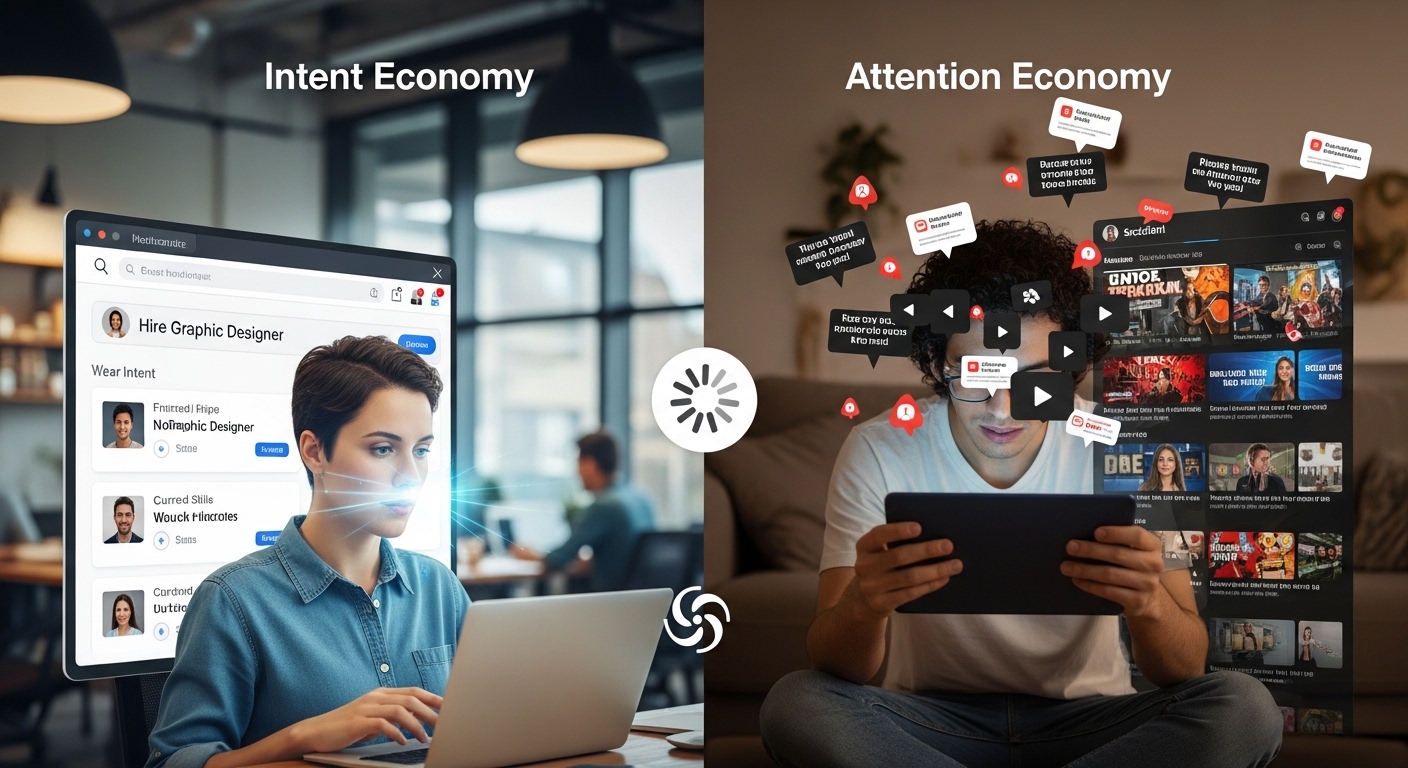
The Attention Economy (TikTok, Instagram) relies on dopamine and viral lottery wins with a 48-hour content lifespan. The Intent Economy (YouTube, Search, Blogs) solves specific problems, allowing content to rank and compound value for years. To build a platform business, shift from renting attention to owning intent.
YouTube (Intent Economy) vs TikTok (Attention Economy): Which Game Are You Playing?
⚡ The 30-Second Summary:
- The Problem: There are two economies running inside the platform economy right now. Most platform earners are in the wrong one for their financial goals.
- The Risk: The attention economy is a lottery designed to keep you producing with no solid returns. The intent economy is an investment fund which generates compound interest if done right.
- The Reality: You cannot change how platforms set the rules, but you can choose how you set your own rules for leverage — which then determines if you are building for a 48-hour expiration or long-term compounded interest.
Platform income is the new salary, and earning through them is the modern way of working.
But different people use platforms differently, and each platform has a different intent. And here is something most platform earners don't realize: there are two games happening in the platform economy. Two completely different games. Different rules. Different odds. Different outcomes.
Most platform earners are stuck playing the attention game. Instead of playing the intent game.
This is what the games look like.
1. The Attention Economy
This is where most platform earners live: TikTok, Instagram, Twitter/X, Facebook.
The game works like this: you create content. You chase views, likes, followers, engagement. You hope it goes viral. Your goal? Get attention. Lots of it. All the time. Because attention = reach. Reach = potential income. Potential income = sponsorships, brand deals, ad revenue.
The problem? Attention has a 48-hour lifespan. You post a video. It gets views for maybe two days. Then it gets lost in the midst of new posts. So you post again. Chase the algorithm. Hope for another viral moment. You're on a hamster wheel.
And the attention economy runs on dopamine. Not yours — the platform's users. They're scrolling. Bored. Looking for entertainment. A quick hit of dopamine. Trends. Outrage. Humor. "I am bored; entertain me." That's the user mindset in the attention economy.
And if you're a platform earner trying to build income here, you're competing for fleeting attention against millions of other creators doing the same thing.
The platform culprits in the attention economy: TikTok, Instagram, Twitter/X, Facebook, Snapchat.
Is it possible to win here? Do you keep providing dopamine? Be entertaining? Ride trends? Hope to go viral? You monetize through brand deals, sponsorships, tips, ad revenue. But the longevity is unstable — all dependent on maintaining attention, all requiring constant content creation. Your content dies in 48 hours. Maybe a week if you're lucky. To keep earning, you keep posting. Forever. That's the hamster wheel.
2. The Intent Economy
Now let me tell you about the other game. YouTube, Pinterest, Amazon, Beehiiv/Substack.
The game works like this: you create content or a product for a persona that has a problem. You post it on the platforms. Create assets, products, or content in the form of lead magnets. Your goal is to drive traffic, engagement, conversions — turning them into paying customers. Because problem identification = traffic. Problem solution = conversions. Problem solving = income (paid products, ads, channel memberships).
The user mindset? "I have a problem; help me solve it." Not bored. Not scrolling. Actively searching. They have intent.
And when someone finds your content through search intent, something different happens. Your content doesn't die in 48 hours. It compounds. A blog post you write today ranks on Google — it gets traffic for months, years, forever. A YouTube video optimized for search gets discovered by people searching for that problem. It works while you sleep. A tool you build gets found by people Googling "[specific problem] calculator." They use it. Some convert to customers.
This is compound interest for content. You build once. It earns forever.
The platforms in the intent economy: YouTube, Pinterest, Amazon/Etsy, Beehiiv/Substack, Fiverr/Upwork.
How do you win here? Focus on solving problems. Provide lead magnets and sales funnels. Drip feed solutions through answering questions. You monetize through education/courses, channel memberships, high-intent sales, subscriptions/products/services. People searching for solutions have intent to solve their problem — some will pay for the solution.
The longevity here is more stable than the attention economy. Your content ranks for years. It compounds. You build once, it works forever — though read the fine print. You are not on a hamster wheel. You could be building, if done right.
3. The Platform Economy Numbers
| Platform | Type | Scale (MAU / users) | Monetisation Power | "Living-income" Difficulty |
|---|---|---|---|---|
| TikTok | Attention | ~1.9B MAU | Very low RPM | Very hard (tiny % succeed) |
| Attention | ~3.0B MAU | Low RPM, brand-deal heavy | Hard | |
| Snapchat | Attention | ~0.9B MAU | Low, spiky | Very hard |
| X | Attention | ~0.6B MAU | Low ad share | Very hard |
| Attention | ~3.1B MAU | Low-medium RPM | Hard | |
| YouTube | Intent | ~2.6B MAU | Medium-high RPM | Medium (clear path) |
| Intent | ~0.55-0.62B MAU | Medium via commerce | Medium | |
| Amazon/Etsy | Intent | 310M buyers / 8M sellers | High transaction value | Medium-hard but very rewarding |
| Fiverr/Upwork | Intent | Millions of clients/freelancers | High hourly value | Medium |
| Beehiiv/Substack | Intent | 255M+/35M+ readers | Very high LTV per subscriber | Medium for skilled operators |
| Uber | Intent (gig work) | ~200M+ consumers; ~8.8M active drivers & couriers | Medium per unit (≈$15-$22 net per engaged hour for many drivers) | Medium — relatively easy to earn, but capped and dependent on trading hours and vehicle costs |
Biggest audience ≠ best income. The platforms on the right of this chart (intent) trade fewer users for higher value per user.
4. Why Are Most Platform Earners On The Wrong Platform
I was alarmed at the numbers from the research. With the number of users, most platform earners are in the attention economy.
Creators on TikTok and Instagram, posting daily, chasing virality, hoping for brand deals. Freelancers on Upwork posting about their services on social media, trying to "build their brand" through content. Gig workers making videos about their day driving for Uber, getting views but not income.
Why are they there? Because the attention economy LOOKS like the path to success, or they like to gamble. You see people go viral. You see influencers with millions of followers. You see outliers get recognised, turn into overnight successes, become instant millionaires. It looks achievable. So they chase it.
But here's what you don't see: for every overnight success, there are millions of creators posting daily and earning nothing. For every viral video that leads to income, there are thousands that die with zero impact or don't even get seen.
The attention economy is a lottery. And most people lose.
The Other Side of the Coin
Not to be biased. Some might consider the intent platform economy the wrong platform too. Many position their business as a problem solver — they create content, utilities, posts, products, market and be seen, in the hopes of being the next Mr Beast, PewDie, Ali Abdaal.
But just like the attention economy, many may not make $50,000 per year working for less than minimum wage. So why do they do it? Because they are ready to play the long game. They are building/creating assets whose ROI compounds in future. They are creating resellable assets. It is like building or buying a house — the capital appreciation pays off in the end.
So for those who get it right, the intent economy is an investment fund.
5. The Intent Economy Is Where You Should Be
Irrespective of the downsides, I believe the intent economy is the place to be.
In the business world, the truly successful own businesses (asset). In the property world, the truly successful own real estate (asset). In other worlds, the truly successful own art, precious metals, stock and shares (asset). So in the intent economy, the assets would be your digital assets.
Let me show you what the intent economy looks like in practice.
Example 1: The Tax Guide. Someone Googles "Uber driver taxes 2026." They find your blog post. It's comprehensive. It solves their problem. At the end, you offer a free tax calculator. They use it. They sign up for your newsletter. Later, they become a customer. That post ranks on Google for years, drives traffic daily, converts searchers into customers, compounds value over time. You wrote it once. It works forever.
Example 2: The Tool. Someone searches "platform fee calculator." They find your tool. It's free. It solves their immediate problem. They see the value. They explore your paid product. That tool ranks on Google, gets shared in communities, builds trust immediately (utility first), converts users to customers. You built it once. It generates leads forever.
Example 3: The YouTube Tutorial. Someone searches "how to report Etsy income on taxes." They find your video. You walk them through it step by step. They subscribe. They watch more videos. They eventually buy your course or SaaS. That video ranks on YouTube search (not just browse), gets discovered by high-intent viewers, builds authority, compounds subscribers over time. You filmed it once. It earns forever.
6. The Real Difference: Dopamine vs Utility
Attention economy: you're competing for dopamine hits. Entertainment. Trends. Virality. Your content needs to be more entertaining than the next video. More outrageous. More engaging. And once they've consumed it? They scroll to the next thing.
Intent economy: you're solving problems. Utility. Answers. Solutions. Your content needs to be more helpful than the alternatives. More clear. More actionable. And once they've consumed it? They bookmark it. They return to it. They share it with others who have the same problem.
Which one builds a business? Utility compounds. Dopamine fades.
But What About the Success Stories?
I know what you're thinking: "What about all the creators making millions in the attention economy?" Fair question.
Here's the thing: those outliers turn the attention into a sustainable income. Those who make millions and even six figures start with an objective in mind — to be a business, a brand, a personality. You'll notice I did not say influencer, creator, or some new-age term. They turned attention into leverage, and leverage into millions.
Most creators do not do this. Most stay on the hamster wheel — posting daily, chasing virality, hoping for the next brand deal. They're trapped in the attention economy. Because here's the uncomfortable truth: the attention economy has winners and losers by design. And most platform earners are not in the winning category.
7. Where You Should Be Building
If you're a platform earner reading this, here is what I would do — and no, I am taking my own advice in building my own business.
Stop chasing attention. Start building in the intent economy.
If you're a creator: don't just post for views. Build tools, resources, guides that people search for. Create content that ranks on search. Own your email list (not just platform followers).
If you're a freelancer: don't just post about your services on social media. Write guides that rank for "[your service] how to." Build case studies, templates, resources. Drive traffic to your owned channels (website, newsletter).
If you're a gig worker: don't just make videos about driving for Uber, and don't stick to just driving. Create "how to maximize Uber earnings" content that ranks. Build tools, products, or guides other drivers search for. Use platform attention to drive to owned assets.
The shift: attention economy = rent (you're renting space on platforms). Intent economy = ownership (you own the traffic source).
And here's the thing about ownership: when you rank on Google for "Uber driver tax calculator," that traffic is yours. Google doesn't change the algorithm overnight and cut your reach by 80%. The search intent doesn't disappear. People will keep Googling that problem. Your content will keep getting found. That's compound interest.
Note: So do you know what your compounded income and financial position looks like? Get your house in order using our free Online Earnings Calculator.
8. Now Let's Talk Financial Numbers
In my previous post on AI moderation and creator demonetisation, I mentioned that every piece of content you produce must belong to you. In the same vein, every single income and expense must be tracked. That financial insight lets you create options so you can have leverage.
"Financial Insight is your Currency of Leverage."
Here is why that matters in the context of everything we just discussed. Most platform earners do not know their real numbers. They know their gross — what the platform shows them. They do not know their net — what actually hits their bank after fees, after taxes, after currency conversion losses, after expenses they forgot to claim. The creators guide breaks that stack down layer by layer, which is the version of this you can actually act on.
That gap between gross and net is where leverage lives or dies. You cannot make a strategic decision if you do not know what your current earnings are and what they can do for you. Financial insight is not accounting. It is the intelligence that tells you where you actually stand so you can make the next move from a position of clarity rather than assumption. That is what I mean when I say financial insight is your currency of leverage.
That financial clarity is what separates a platform earner from a platform business owner.
So do you know what your compounded income and financial position looks like? Start with our free Platform Earnings Health Check at PlatformTaxHub — not because it solves the attention vs intent question, but because you cannot build leverage on a foundation you cannot see.
Final Thought
We all participate in both platform economies — intent and attention. However, it is your objective or end goal that matters and determines your expected outcomes. The platforms will not tell you which game serves you better. They will keep showing you the lottery winners and making the attention game look like the obvious path. That is by design.
But you are reading this. Which means you are already asking a different question. Not "how do I go viral" but "how do I build something that compounds." That is the right question.
Now go find the right answer for your specific situation — your platforms, your income model, your financial baseline. Because the intent economy is not one-size-fits-all either. It rewards the earner who understands their own numbers well enough to make a deliberate bet.
Conclusion
The platform economy is not going anywhere. It has turned into the modern way of working. But the rules of the game are shifting faster than most earners realise.
The attention economy will keep producing lottery winners. A handful will turn that attention into leverage and build something real. Most will stay on the hamster wheel — posting, chasing, hoping.
The intent economy will keep rewarding the earners who show up with a problem to solve rather than content to push. It is slower. It is less glamorous. It does not produce overnight success stories the platforms can use to recruit the next wave of creators. But it compounds.
And in a world where platform algorithms change overnight, creator funds disappear without warning, and demonetisation can happen to anyone — compound interest is the only income strategy that makes sense.
The question is not which platform you are on. It is which game you are playing on that platform. Choose deliberately.
P.S. Stop the Friction in Your Own Finances
I'm building PlatformTaxHub to solve the same friction I wrote about today — specifically the nightmare of tracking multi-platform, multi-currency earnings. If you're tired of the spreadsheet chaos, tracking income volatility, or underestimating your taxes, use our resources to take back control:
- Track Your Income: See what's actually hitting your pocket with the Income Tracker.
- Extrapolate Your Net Profit: Normalise irregular independent-worker income with Net Profit & Financial Insights.
- Know Where You Stand Before You File: The Tax & Compliance Suite produces a tax estimate and a filing-readiness checklist so you go into your return prepared. It does not file anything for you.
- Scale Your Brand/Business: Use the Platform AI Growth Engine to personalise your earnings growth.
Don't let platforms treat you like paperwork. Start treating your platform work like a business.
The Platform Transparency Series
This is one of nine pieces that go inside the platforms people earn from. The full series, and how it fits with our research, is at The Platform Transparency Series.
- How Much Does YouTube Actually Pay? The Fee Layers Between AdSense and Your Bank Account
- How Much Does Upwork Take? What Freelancers Really Keep After Fees, Connects and VAT
- How Much Does Uber Take From Drivers? Gross Fares, Fees and What You Actually Keep
- How Much Does Etsy Take? The Full Fee Stack Eating Seller Margins
- How Much Does Airbnb Take From Hosts? Fees, Pass-Throughs and What You Actually Keep
- How Much Does Gumroad Take? The 10% Fee, the 30% Discover Rate and What Reaches You
- The Platform Friction Crisis
- The AI Trained to Fight AI Slop is Catching Real Creators. Could You Be Next?
Frequently Asked Questions
Work this out for yourself
Mason O.
FCCA FellowFounder, PlatformTaxHub | Author of the Platform Transparency Series
I help multi-platform earners know what they're actually keeping — through the Platform Transparency Series, the weekly Platform Income Stack newsletter, the PIOS framework, and PlatformTaxHub, the SaaS operating system that runs it. FCCA Finance Transformation Expert, two decades in FTSE 250 global companies.
👉 Get your free Platform Earnings Health Check