Finance tools recognise that people earn in several ways, but they still process each stream on its own. Someone earning across five platforms ends up with five separate pictures instead of one, and fills the gaps by hand or in a spreadsheet. The answer is not another app but a layer that sits above them and reads every source as one total income.
Why We Don't Need More Apps For Tracking Multiple Streams of Income
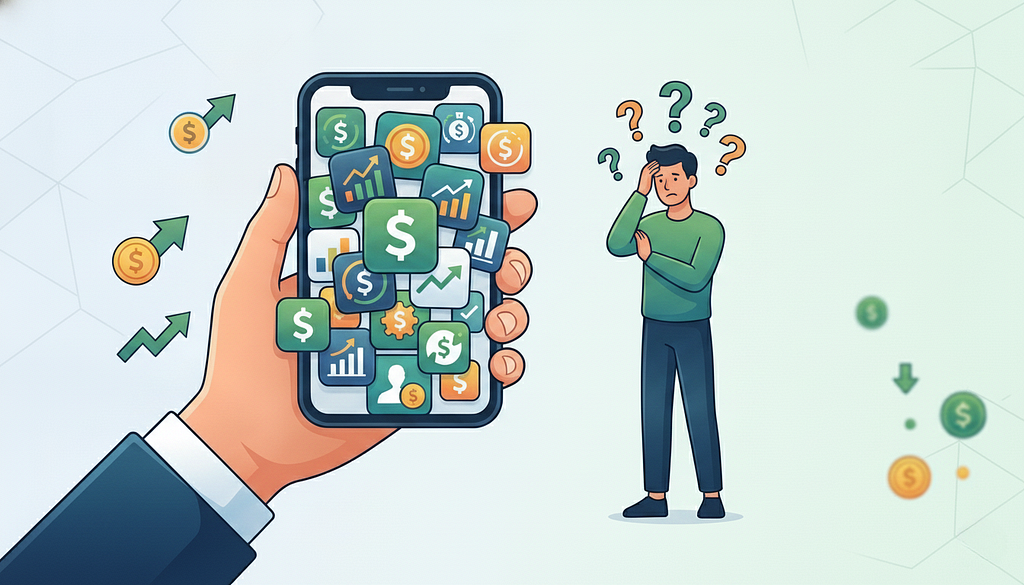
There's a strange gap in how we talk about multiple streams of income online
A lot of posts talk about the various tools for tracking income, invoicing clients, managing budgets, converting currencies, calculating and filing taxes.
However, this does not address the reality of how people earn and manage their money in modern ways of working.
And those two worlds don't fully align anymore.
Most financial tools are being built knowing that regardless of whether people have one job, they could still have "side hustles".
They recognise that people earn in multiple ways — side hustles, freelance work, content creator, digital products, ecommerce and much more.
But the way they handle it using the tools available hasn't fundamentally changed.
Each income stream is still viewed as one single income stream.
So if you're earning across five platforms, you don't experience it as one financial picture.
You end up managing it as five different ones.
You record income in one place. Expenses in another. Invoices somewhere else. Tax tracking somewhere else again. And possibly an exchange rate tool to convert any foreign currencies.
Sometimes even using different tools just to keep up with each stream.
So instead of one coherent view of your income, you get fragmentation at the system level.
Not because tools ignore multiple income streams — but because they still process them in silos.
And that's where the gap actually lives.
So the result is that people end up forcing multiple incomes into systems that were never designed to interpret it as a whole.
Even strong tools like QuickBooks get used this way — not because they're wrong, but because they're being applied to something more complex than their structure can naturally represent or were built at a time when the only recognised "side hustle" was freelancers who produced invoices.
And in using the software, tools and apps, you have to do quite a lot of work to fill in the gaps or give up and end up using spreadsheets.
But that does not help solve the distortions in how you understand your own financial reality or numbers.
The problem isn't just technical.
It's conceptual.
The way people earn has changed faster than the way we've built systems to interpret it.
This is most visible in creator and gig-based income where people are now combining:
- platform payouts
- Task-Based/Piece-Rate Pay
- affiliate revenue
- Project-Based Fees
- brand deals
- Hourly Rates
- and sometimes traditional employment
It's not really "multiple income streams" in the clean sense anymore.
It's fragmented income identity.
And that distinction matters more than it gets credit for.
Because people aren't just trying to track money.
They are trying to see the whole picture, the way a payslip shows it: one gross figure, one net figure, and every deduction in between.
They bring that expectation to platform income, and it does not survive contact. Tracking answers only the first of these questions:
What came in in total this month? What does that mean financially? Am I stable? How much do I really have? Can I plan? Can I borrow? Can anyone else trust my income pattern?
That layer is mostly missing.
This is where the idea of an Income Operating System Framework starts to make sense.
Not another dashboard.
Not another finance app.
But a system that sits above everything else and interprets income across sources.
Not just recording it — but turning it into something coherent enough to reason about.
Because right now, most tools are still retrospective.
They show what happened and often not in real time.
The real time apps only show a piece of the picture.
But modern income doesn't feel retrospective.
It feels live, fragmented, and constantly shifting.
So what is needed instead
Not another app. A layer above the apps.
The distinction matters, because "one more tool" has been the answer for a decade and the gap has not closed. A tool records a source. What is missing is something that reads every source together and turns it into one position. Three things have to happen, in order, and no single-source tool can do any of them on its own:
Add the sources up as one total. Not five streams listed next to each other on five dashboards, but one figure covering platform payouts, client work, affiliate revenue, brand deals and any employment income alongside them. If answering that question still requires five logins, the total does not really exist.
Put them on the same basis. One platform reports gross before a 20% commission and another reports after it; one pays in USD on the 15th, another in GBP thirty days later. Until those are expressed in the same currency, over the same period, with fees already removed, adding them together produces a number that means nothing.
Estimate tax as it happens. Against the filings actually coming, while the income arrives, rather than reconstructing the year from memory each spring.
Those three are Consolidation, Normalisation and Estimation — the Income Clarity Framework, where each is set out in full.
Why this is not just another dashboard
Most tools are retrospective. They show what already happened, frequently not in real time, and the real-time ones show one slice of the picture.
Modern income is not retrospective. It arrives live, from several directions, and keeps shifting. A system that interprets it has to work the same way.
This is where PlatformTaxHub comes in — not as a tax tool, despite the name, but as a way of connecting fragmented income into one structure that can be understood at a glance: visibility across platforms, what is actually earned after fees and timing differences, and tax obligations flagged across jurisdictions.
Individually those are useful. Together they are the difference between managing money and guessing at it.
That is why I built it. I was tired of watching capable people operate with financial blindness, not because they were careless but because nothing they had was built to show them the whole picture.
The basic utility tools are free to use, because a clear financial identity should not be a premium luxury.
Volatility is the other half of this picture: The Rise of Online Income and Its Invisible Volatility.
Frequently Asked Questions
Work this out for yourself
Mason O.
FCCA FellowFounder, PlatformTaxHub | Author of the Platform Transparency Series
I help multi-platform earners know what they're actually keeping — through the Platform Transparency Series, the weekly Platform Income Stack newsletter, the PIOS framework, and PlatformTaxHub, the SaaS operating system that runs it. FCCA Finance Transformation Expert, two decades in FTSE 250 global companies.
👉 Get your free Platform Earnings Health Check