Table of Contents
- At a glance
- 1. Upwork: what the client paid, before Upwork's fee
- 2. Uber: gross fares, before Uber's service fee
- 3. Airbnb: the booking, cleaning fee included
- 4. Etsy: the sale, shipping included, before three kinds of fee
- 5. YouTube: your share of the revenue, before tax withheld
- 6. Gumroad: the sale price, before a percentage-plus-flat fee
- 7. Fiverr: your side of the order, not what the buyer paid
- 8. DoorDash, Instacart and delivery apps: earnings, tips included
- 9. Stripe and Shopify Payments: total processed, refunds not netted off
- 10. Patreon: pledges collected, before two fees
- 11. TikTok creator programmes: what TikTok credits you
- 12. PayPal and direct invoicing: every payment received
- The pattern across all 12
- Frequently Asked Questions
The income a platform reports is not the amount you were paid. Marketplaces (Upwork, Fiverr, Etsy, Airbnb, Uber and similar) report your gross earnings before their fees, so the reported figure is higher than your deposit and the difference is a fee you can usually deduct. Revenue-share programmes (YouTube, TikTok) report your share of the revenue, before any tax withheld. Either way, your income is the reported figure, not the deposit, and if you earn on several platforms you have to add them up yourself.
The income figure a platform reports and the amount that reaches your bank are two different numbers. The reported figure is your income. The deposit is what is left after the platform has taken its fees, and sometimes tax, on the way through.
If you earn from one platform, that gap is one thing to understand. If you earn from three, five or more (freelancing on Upwork, selling on Etsy, renting a room on Airbnb, driving for Uber), each platform opens its own gap, reports on its own schedule, and knows nothing about the others. None of them gives you your total.
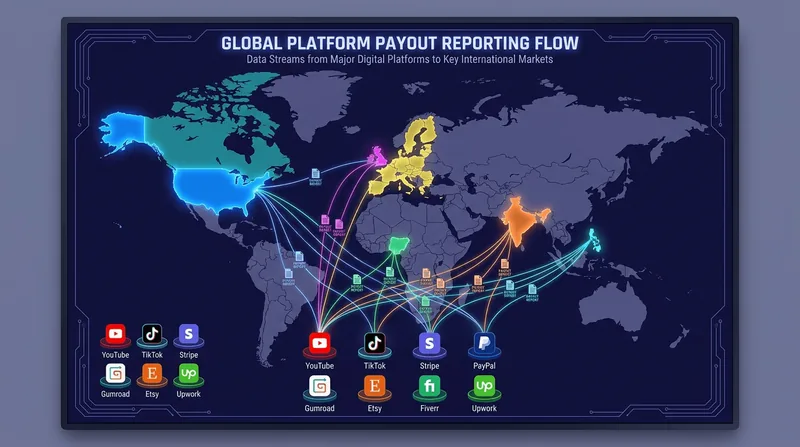
This roundup sets out, for 12 major platforms, what the reported figure includes, what comes off before you are paid, and what to track so the two reconcile.
At a glance
| Platform | The figure it reports as your income | What comes off before you are paid | What to track |
|---|---|---|---|
| Upwork | What the client paid for your work | Upwork's service fee, set per contract | Billings per contract, and the fee on each |
| Uber | Gross fares the rider paid | Uber's service fee | Gross fares, the fee actually charged |
| Airbnb | The booking, including the cleaning fee | The host service fee | Each booking, the fee, the exchange rate on each payout |
| Etsy | The sale, including shipping the buyer paid | Listing, transaction and payment-processing fees | All three fee types as separate lines |
| YouTube | Your share of the revenue | Any US tax withheld (non-US creators) | Revenue by month earned, and tax withheld |
| Gumroad | The sale price | A percentage fee plus a flat fee per sale | Each sale, the fee, and refunds |
| Fiverr | The order value on your side | The seller service fee | Order value, not the buyer's total |
| DoorDash and delivery apps | Earnings including tips | Nothing you can see as a fee | Earnings with tips, and your own mileage |
| Stripe and Shopify Payments | Total payments processed | Processing and platform fees; refunds are not netted off | Processor totals against store sales |
| Patreon | Pledges collected | Platform fee and payment-processing fee | Pledges, and both fees separately |
| TikTok creator programmes | What TikTok credits you | Nothing you can see as a fee | Credits by month earned |
| PayPal and direct invoicing | Payments received | Processing fees | Every invoice, in the same ledger as your platforms |
Fee levels change, so this table describes what is deducted rather than how much. Each platform's own fees page has the current rates.
1. Upwork: what the client paid, before Upwork's fee
Upwork reports the full amount a client paid for your work (gross billings), not your deposit. The client's own marketplace fee is charged on top and is not part of your income. Upwork's service fee is set per contract rather than at one fixed rate: as of September 2026 it is a variable 0–15%, shown on each contract (Upwork's current fees; the Upwork breakdown covers how it changed). Payouts land net of that fee, in the currency your account is set to.
What to track: gross billings per contract, the fee rate shown on each contract, and the fee amount as a separate deductible expense.
2. Uber: gross fares, before Uber's service fee
Uber reports gross fares, the full amount the rider paid, before deducting its service fee, which varies by market, trip and vehicle type. In the US that gross figure is what appears on the 1099-K (the 1099-K guidecovers who receives one). Filing the deposit as income and skipping the fee deduction is one of the most common mistakes drivers make.
What to track: gross fares (not payout), the service fee actually charged (it varies by trip and promotion), and any booking or airport fees passed through.
3. Airbnb: the booking, cleaning fee included
Airbnb reports the booking: nightly rate, cleaning fee and any extras, before deducting the host service fee. The cleaning fee a guest pays is part of your rental income. What you pay a cleaner is the expense, recorded separately.
Currency matters here too. Hosts renting to international guests may see bookings priced in one currency and paid out in another, and the rate Airbnb applied is not necessarily the rate your tax authority expects you to use.
What to track: each booking in full, the host service fee, what you spent on cleaning, and the exchange rate that applies to each payout.
4. Etsy: the sale, shipping included, before three kinds of fee
Etsy reports the sale including the shipping the buyer paid, before any fees. Its fees come in three layers: a listing fee per item, a transaction fee on the sale price plus shipping, and a payment-processing fee. Payouts can arrive daily, so sellers build up dozens of small transactions with three fee types attached to each.
What to track: the sale price including shipping charged to the buyer, then listing, transaction and payment-processing fees as three separate deductible lines, not one bundled "Etsy fee".
5. YouTube: your share of the revenue, before tax withheld
YouTube works differently from a marketplace. It doesn't report the total advertisers paid and then deduct a fee: it reports your share of the revenue, under the YouTube Partner Program terms for each revenue type. For non-US creators, Google may withhold US tax on earnings from US viewers, and that withholding comes out of the payout, not out of your income. Your income is your share before withholding.
Payments arrive the month after the earnings, which trips up creators matching income to the month it was earned.
What to track: revenue by the month it was earned (not the month it was paid), and any tax withheld, which may be creditable against your home-country tax bill under a treaty. If that credit isn't claimed, the same earnings are taxed twice. The mechanics are set out inthe double taxation trap.
6. Gumroad: the sale price, before a percentage-plus-flat fee
Gumroad charges a fee that combines a percentage of the sale price with a small flat charge per transaction, and reports the sale price before that fee. Digital product sellers who use Gumroad alongside other platforms often undercount it, because payouts are fast and feel like money that has already been netted.
What to track: the sale price per transaction, the combined fee, and refunds and chargebacks, which reduce income but are often missed.
7. Fiverr: your side of the order, not what the buyer paid
Fiverr charges sellers a service fee on the order value, and separately adds a service fee on top for buyers. So the amount the buyer paid and the amount reported as your earnings are not the same number. Your income is the order value on your side, before Fiverr's seller fee. Earnings become available to withdraw after a clearing period, so the date you were paid can fall well after the date the order completed.
What to track: the order value on your side (not the buyer's total), the seller service fee, and currency conversion if your account currency differs from your buyers'.
8. DoorDash, Instacart and delivery apps: earnings, tips included
Delivery and shopping platforms report earnings that include base pay and customer tips. Tips are taxable income and sit inside the reported figure, even though they feel separate from platform pay. There is usually no visible platform fee to deduct: the costs that matter are your own mileage and vehicle expenses, which the platform doesn't calculate for you. US workers typically receive a 1099-NEC or 1099-K with this figure (see the1099-K guide).
What to track: earnings including tips as the platform reports them, and your own mileage and vehicle expenses kept separately.
9. Stripe and Shopify Payments: total processed, refunds not netted off
For online sellers, Stripe and Shopify Payments report the total payments processed through the account, before Stripe's processing fee, before Shopify's platform fee, and without subtracting refunds. Sellers running Shopify with a separate payment processor often have two fee layers and two sets of reports, the store's sales reports and the processor's, and those have to be reconciled against each other as well as against the bank.
What to track: the processor's total, reconciled against the store's own sales reports, with refunds and chargebacks recorded as reductions to income rather than ignored.
10. Patreon: pledges collected, before two fees
Patreon reports the pledges collected from patrons, then deducts a platform fee (which depends on your plan) and a separate payment-processing fee before paying out. Creators running Patreon alongside YouTube or a Gumroad shop often have three different fee structures for what is, in effect, one audience paying them three ways.
What to track: pledges per month, the platform fee and the payment-processing fee as separate lines, reconciled monthly rather than at year end.
11. TikTok creator programmes: what TikTok credits you
TikTok's creator programmes pay according to their own calculation of views, engagement and eligibility. Like YouTube, this is a share, not a sale with a fee taken off: the amount TikTok credits you is your income, and there is usually no separate fee to deduct. The risk is different: because the calculation is opaque, creators struggle to check it, and brand deals or affiliate income paid outside the programme get left out.
What to track: credits by the month they were earned, recorded as business income, kept separate from brand-deal and affiliate income so nothing is counted twice or missed.
12. PayPal and direct invoicing: every payment received
Freelancers and sellers who invoice clients directly and collect through PayPal or a similar processor have no marketplace keeping a record for them. The processor reports what you received (in the US, on a 1099-K once you cross the federal threshold; the1099-K guide has the details), separately from any marketplace reporting. This is the income most often missed, because nothing prompts you to reconcile it. It arrives quietly, invoice by invoice.
What to track: every direct invoice and payment-app receipt as business income, in the same ledger as your marketplace platforms, not treated as informal money because no marketplace was involved.
The pattern across all 12
Three things hold across every platform above:
- Your income is the reported figure, not the deposit. Marketplaces report before their fees; revenue-share programmes report your share before any tax withheld. Either way, the amount in your bank is the wrong number to file.
- Each platform reports on its own. Each platform, and each tax authority that receives its data, sees only its own slice. None of them add up your platforms or convert the currencies into the one your return needs.
- Each platform pays on its own schedule. Daily, weekly, monthly, or after a clearing period. Matching each payment to the period it was earned in is a step every multi-platform earner has to do themselves.
This applies wherever you live. Which tax authority receives a platform's report, and when, depends on your country: the platform reporting rulesset out who reports and who withholds, country by country, and the countries pagecovers what PlatformTaxHub supports where you are. But the gap between the reported figure and the deposit comes from how platforms take their fees, so it exists everywhere.
For someone earning on four or five of these platforms, that means four or five fee structures, currencies and payment schedules that all have to add up to one gross income figure, in one currency, before anything can be filed correctly. That reconciliation, not any single platform's fees, is the real multi-platform problem. It is also why the tax authority often has a more complete picture of your earnings than you do, the position described inmulti-platform income strain.
Frequently Asked Questions
Mason O.
Founder, PlatformTaxHub | Creator of the Platform Income Operating System™ | Author of the Platform Transparency Series
I help multi-platform earners know what they're actually keeping — through the Platform Transparency Series, the Platform Income Stack newsletter, the PIOS framework, and PlatformTaxHub. Finance Transformation Expert and former Financial Controller, two decades across the Big Four, FTSE 100 and global brands.