Table of Contents
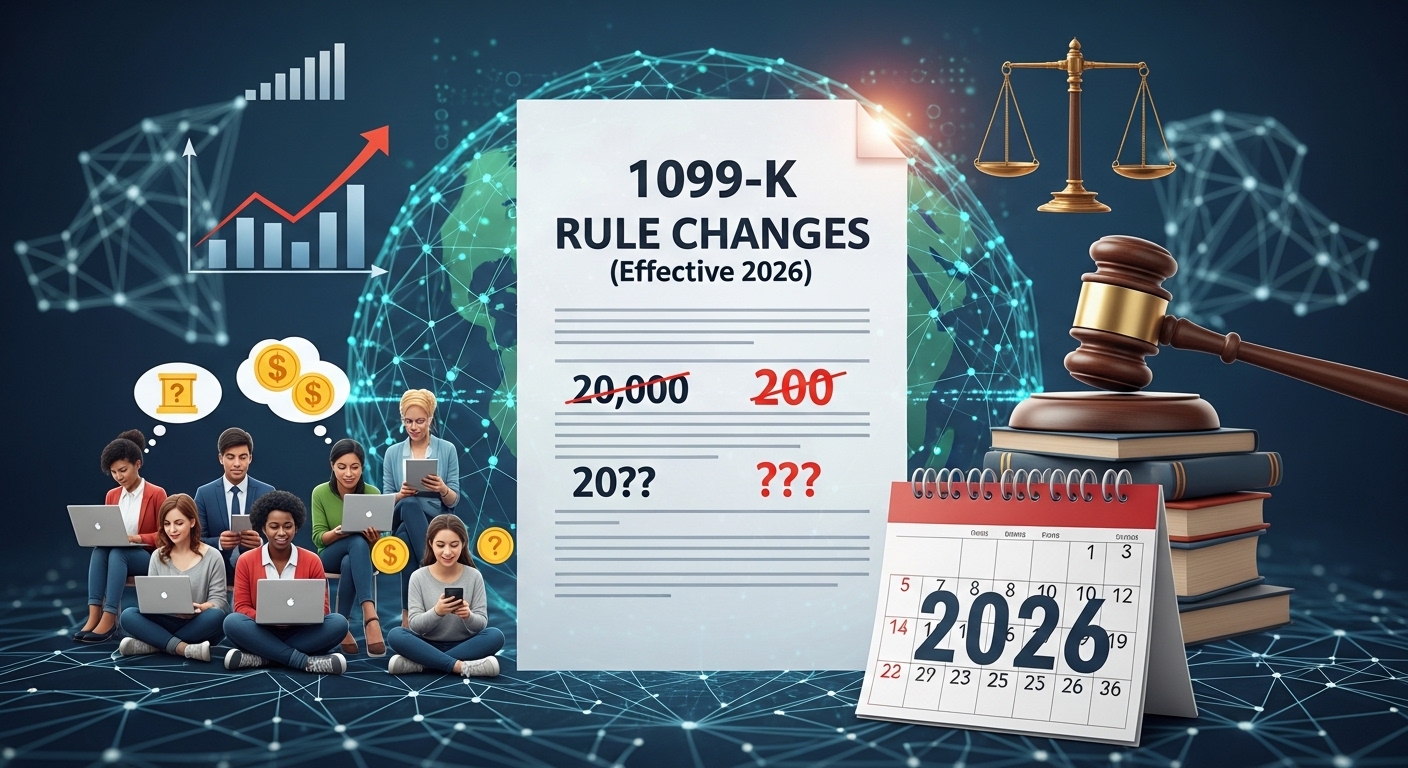
The federal 1099-K threshold is $20,000 and 200 transactions. The planned $600 threshold was reversed. Several states maintain thresholds as low as $100–$600. Income is taxable regardless of whether a form is issued.
1099-K in 2026: What Actually Changed, What Got Reversed, and What It Means If You Earn on Platforms
Tax rates and thresholds change every tax year. The 2026 US figures here were checked in September 2026; for the current position see IRS self-employment tax. General information, not advice on your own return.
If you have been trying to keep up with 1099-K rules over the past few years, you are not alone in finding them confusing. The threshold changed in 2021, got delayed in 2022, delayed again in 2023, partially implemented in 2024, and then reversed entirely in July 2025. At this point, a significant number of gig workers, freelancers, and online sellers are operating on outdated information — some preparing for a $600 threshold that no longer exists, others unaware that their state has its own rules that the federal reversal did not touch.
This article sets the record straight on where the rules actually stand in 2026, what they mean for how you file, and the compliance gap that catches out earners in certain states every year.
The Whiplash Timeline: How We Got Here
Understanding the current rules requires a brief history, because the confusion is real and has a legitimate cause.
The original rule (pre-2022): Platforms and payment processors were required to issue a 1099-K only if a payee received more than $20,000 and completed more than 200 transactions in a year. Both conditions had to be met. This had been the rule since 2008.
The American Rescue Plan Act (March 2021): Buried inside the pandemic relief bill was a provision that dramatically lowered the 1099-K threshold to $600 with no transaction minimum — matching the longstanding threshold for other 1099 forms. The intent was to capture unreported income from the expanding gig economy. The change was supposed to take effect in 2022.
The IRS delays and reversal (2022–2025): Recognizing the confusion this would cause for taxpayers, the IRS announced a delay for the 2022 tax year, keeping the old rule in place. They delayed it again for 2023, then announced a transitional threshold of $5,000 for 2024. Finally, in late 2025, the IRS reversed the plan entirely, announcing that the $20,000 and 200-transaction threshold would remain in effect for the foreseeable future.
The result: for 2025, 2026, and all future years under current law, the federal 1099-K threshold is back where it started — more than $20,000 in gross payments and more than 200 transactions from a single platform. Both conditions must be met.
What the Current Rules Actually Mean
The threshold applies per platform, not in aggregate
This is one of the most commonly misunderstood aspects of the 1099-K rules. If you earn $12,000 on Etsy and $10,000 on Upwork, neither platform individually crosses the $20,000 threshold — so neither is required to issue you a 1099-K, even though your combined platform income is $22,000.
The threshold is assessed independently by each platform based on payments it processed for you. If no single platform exceeds both $20,000 and 200 transactions, you may receive no 1099-K at all — regardless of your total income across all platforms.
This does not mean the income is not taxable. It is. Every dollar of self-employment income above $400 in net earnings must be reported, with or without a form. The 1099-K threshold governs what gets reported to you and the IRS by the platform. It does not govern your filing obligation. The US form is only one of the reporting regimes an earner sits inside — how twelve platforms report your income around the world sets out what each one passes on, and on what schedule.
Gross payments, not net — and why this matters
The 1099-K reports the gross amount of payments processed through the platform before fees. If you earned $25,000 gross on Fiverr and received $20,000 after their 20% commission, your 1099-K shows $25,000. That is the number the IRS sees.
On your tax return, you report $25,000 as gross revenue and deduct the $5,000 in platform fees as a business expense. Your taxable net income is $20,000 — which matches what arrived in your bank account. But if you only tracked the bank deposits and reported $20,000 as your revenue without the corresponding deduction, your return shows $20,000 where the IRS expects to see $25,000. That mismatch triggers an automated notice.
This is why keeping your platform statements — the ones that show gross earnings and fees separately — is not optional. They are the documentation that explains the gap between your 1099-K and your tax return. (Use our Platform Fee Calculator to verify your gross vs net figures).
Payment card transactions have no threshold
The $20,000/200 transaction threshold only applies to third-party settlement organisations — payment apps and online marketplaces. It does not apply to payment card transactions. If a customer pays you directly by credit or debit card through a merchant processor, that processor is required to issue a 1099-K for any amount, including a single $10 transaction.
For most platform earners this distinction is invisible because the platform handles all payment processing. But if you also accept direct card payments through a separate processor — Stripe, Square, or similar — you may receive a 1099-K from them regardless of your transaction volume.
The State-Level Trap Most Earners Miss
Here is where it gets complicated again — and where many platform earners get caught out even after learning that the federal threshold is back to $20,000.
Several states never adopted the federal threshold and maintain their own lower requirements. These state rules were not affected by the OBBBA. They apply regardless of what the federal rules say.
States with a $600 threshold and no transaction minimum:Massachusetts, Maryland, Vermont, Virginia, Montana, and Washington D.C.
States with a $1,000 threshold:Illinois (with a minimum of four transactions) and New Jersey.
Rhode Island: $100 — the lowest threshold in the country.
What this means in practice: if you live in Massachusetts and earned $8,000 on Etsy in 2025, Etsy is not required by federal law to issue you a 1099-K. But because Massachusetts requires reporting at $600, Etsy may issue you a state-equivalent form — and the Massachusetts Department of Revenue has a copy of your earnings even though the IRS does not.
The critical point is that your state tax return must reflect this income regardless of which forms you received. But the existence of a state 1099-K and the absence of a federal one creates a reconciliation issue that catches unprepared earners off guard at state filing time.
If you live in any of the states listed above, assume you will receive a 1099-K from any platform where you earned above the state threshold — and ensure your records reflect the gross income figure on that form.
What About the 1099-NEC for Freelancers?
Separate from the 1099-K, the Form 1099-NEC is used by businesses to report direct payments to independent contractors. As of early 2026, the reporting threshold for the 1099-NEC remains at $600. While there have been legislative proposals to increase this amount, no changes have been enacted.
The practical implication: your own income records become more important, not less, as formal reporting decreases. If you are paid $1,800 directly by a client in 2026, no 1099-NEC will be issued — but you still owe self-employment tax on that income, and you need your own record of it.
How 1099-Ks and 1099-NECs Can Overlap
Many platform earners receive both types of forms, which can create apparent double-counting that needs to be reconciled carefully.
Consider a freelance designer who works through Upwork. Their client pays Upwork, which pays the designer. If the designer earns more than $20,000 through Upwork in a year, Upwork issues a 1099-K reporting those gross payments. If the client also attempts to issue a 1099-NEC for the same payments, the designer's income would appear twice.
In this scenario, the 1099-NEC from the client is incorrect — payments made through a third-party platform like Upwork are the platform's reporting responsibility, not the client's. But not every client knows this, and not every designer knows to flag it.
If you receive both a 1099-K from a platform and a 1099-NEC from a client for what appears to be the same income, you need to determine whether they are genuinely separate payments or inadvertent double-reporting. Reconciling this requires having your own detailed transaction records — which is another reason that downloading and keeping your platform CSVs throughout the year is not optional.
What You Actually Need to Do
The rules are complex but the actions required of earners are straightforward.
Report all income regardless of forms received. The 1099-K threshold determines what gets reported to you. It does not determine your filing obligation. If you earned it, it is taxable. See the IRS guidance on Form 1099-K for current thresholds and reporting requirements.
Know your state threshold. If you live in Massachusetts, Maryland, Vermont, Virginia, Montana, Washington D.C., New Jersey, Illinois, or Rhode Island, you are subject to state-level reporting requirements that are significantly lower than the federal threshold. Check your state's current rules — they are not uniform and some states update them independently.
Keep your platform statements showing gross earnings. Your 1099-K reports gross revenue before fees. Your tax return needs to show the same gross revenue with fees deducted as a business expense. The only way to reconcile these accurately is to have the platform statement that shows both figures. A bank statement showing what arrived after fees is not sufficient.
Reconcile any 1099-K you receive against your own records. Platforms can issue 1099-Ks with errors — including transactions that were refunded, reversed, or personal rather than business. If the figure on your 1099-K does not match your records, the platform can issue a corrected form. Do not simply report whatever the form says if you believe it is wrong.
Track quarterly estimated payments. None of the 1099-K rule changes affect quarterly estimated tax obligations. If you expect to owe $1,000 or more in federal tax for the year, you are required to make quarterly payments. The 1099-K you receive in January is for the prior year — it tells you nothing about what you owe in the current year. Your own running income records are what you need for quarterly estimates.
The Bigger Picture
The four-year saga of the 1099-K threshold is a useful reminder of something that experienced platform earners already know: the rules governing your income reporting are not stable, and the responsibility for staying current falls on you, not on the platforms or the IRS.
The OBBBA restored the $20,000/200 transaction threshold and called it settled law. That may be true — or Congress may revisit it again. What will not change is the underlying reality: all self-employment income is taxable regardless of what forms you receive, the platforms are reporting your gross earnings to the IRS when thresholds are met, and the gap between your reported income and the IRS's records is always your problem to explain.
Clean records, accurate gross income tracking, and a current understanding of both federal and state requirements are not optional extras for active platform earners. They are the baseline.
For the full system for tracking multi-platform income correctly, see Platform Tax Guide 2026. For how to structure records that survive scrutiny, see Audit-Proof Your Platform Income. For the fee structures that determine the gap between your 1099-K figure and your bank deposits, see Which Platforms Take the Most From Your Earnings.
Platform fees change without notice. The fee figures in this article were checked in September 2026 and are used as worked examples, not as current rates. For what a platform charges today, see Fiverr.
Frequently Asked Questions
Work this out for yourself
Mason
FCCA FellowFounder, PlatformTaxHub | Author of the Platform Transparency Series
I help multi-platform earners find the income their dashboards are hiding — and keep more of what they actually make. Fellow of Certified Accountants and former Finance Transformation specialist with decades of experience across FTSE 250 and global organisations. PlatformTaxHub was built after experiencing the platform income problem firsthand and seeing what tax authorities have planned for the earners who aren't ready.
👉 Get your free Platform Earnings Health Check