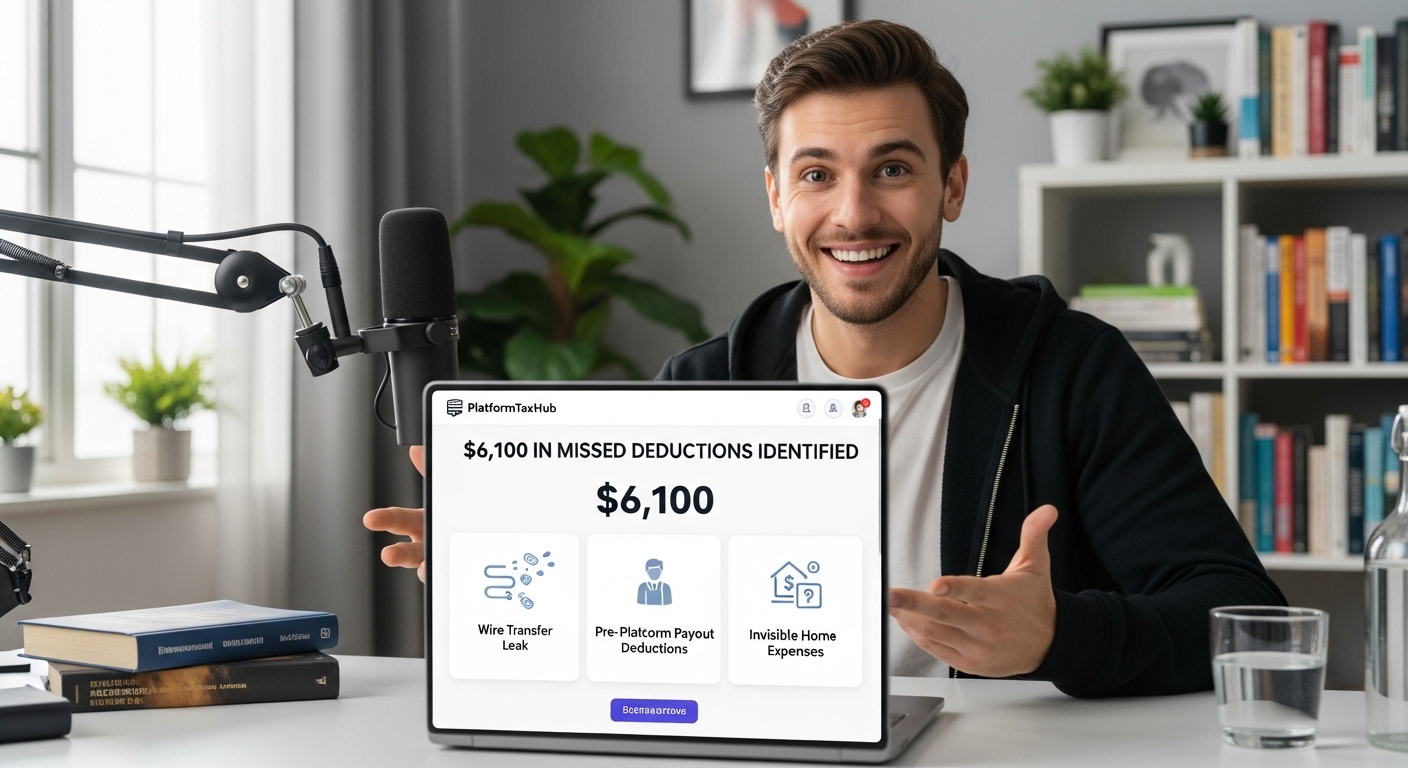
Creators who track by bank deposit miss phantom income — money legally earned but deducted by platforms or consumed by wire fees before arrival. The result is under-reported income, unclaimed deductions, and a growing discrepancy with what platforms report to tax authorities.
YouTube: The $6,100 Phantom Income Trap That Catches Creators Off Guard
Tax rates and thresholds change every tax year. The 2026/27 UK figures here were checked in September 2026; for the current position see gov.uk income tax and self-employed NI. General information, not advice on your own return.
The YouTube creator phantom income trap — where creators pay tax on gross earnings that include platform-deducted fees they never received — is one of the most widespread filing errors in the creator economy. It affects creators in every country where YouTube pays out AdSense revenue, processes Super Chats, or facilitates brand deals.
Ali Abdaal was a junior doctor and a growing YouTuber — one of the few creators who publicly documented his income in real detail. AdSense breakdowns, affiliate earnings, sponsorship rates, and the systems he used to track it all. That transparency made his early financial history one of the clearest windows available into how multi-platform creator income actually works before professional management arrives.
Looking back at those income reports, there is a structural tax problem embedded in almost every creator at that stage. Not fraud, not avoidance — just a fundamental misunderstanding of how platform income should be recorded.
This case study applies the PlatformTaxHub audit framework to a financial profile mirroring Ali's early operations — YouTube AdSense, Amazon Affiliates, wire-transferred sponsorships, and course platform sales — and then asks: if this same scenario played out in 2025/2026, what would the stakes look like?
The Profile:Platforms: YouTube AdSense, Amazon Affiliates, direct sponsorships via wire transfer, course platform sales. Annual gross income: approximately $88,000 equivalent. Tracking method: bank deposits and a personal dashboard.
Part 1 — The Original Trap (How It Played Out Then)
The "Bank Deposit" Tracking Problem
Bank account tracking has one fundamental flaw: it only captures money that arrived. It does not capture money that was earned, deducted by the platform, and never sent. It does not capture the full contract value of a sponsorship when wire fees consumed the difference in transit. It does not capture gross course sales from which the platform silently removed its cut before paying out.
The result is phantom income — money that legally exists as taxable income but that the creator never saw, never tracked, and never claimed as a deductible expense. This is the same gross-versus-net reporting problem that affects every type of platform earner, but for creators it compounds across multiple revenue streams simultaneously.
The Wire Transfer Leak. A sponsor agreed to pay $61,800 for a video integration. The creator's bank account received $60,000 after intermediary bank fees and currency conversion consumed approximately $1,800 — around 3% of the transfer.
This is a tax mistake in two directions at once. First, $61,800 is the legally earned amount — the figure the sponsor will report to their local tax authority as a business expense paid to you. Filing $60,000 creates a discrepancy. Second, the $1,800 in wire and FX fees is a deductible business expense that was never claimed because it never appeared as a visible cost on a bank statement.
International payment leakage is one of the most overlooked deductible costs for creators receiving cross-border payments. Whether you are in the UK receiving USD, in Germany receiving USD, in Australia receiving GBP, or in India receiving USD — the conversion spread and intermediary bank fees are a business expense incurred to receive business income. Use the Currency Take-Home Calculator to model exactly how much of a contracted amount will actually land in your account after fees and conversion spread.
The Course Platform Deduction Gap. The creator sold $27,500 in courses. The platform deducted transaction fees and commissions before each payout. The bank received $25,000. The creator reported $25,000. The correct approach: report $27,500 gross, claim $2,500 in platform fees as a business expense. The taxable profit is identical — but the revenue figure is accurate, and the $2,500 deduction is claimed.
This pattern is universal across every course and digital product platform — Teachable, Kajabi, Thinkific, Podia, Gumroad. Each deducts fees before payout. Each reports the gross figure to tax authorities. The platform fee comparison shows how these rates differ across platforms and why aggregate estimation always understates actual fees.
The Home Studio Write-Off. Filming in a dedicated room representing 15% of a rented flat. Annual rent and utilities approximately $24,000. Business use portion: $3,600. Conservative claim: $1,800. Unclaimed because the creator assumed renting disqualified them from a home office deduction. It does not — in any major jurisdiction.
Most countries allow a business-use-of-home deduction for renters. The US offers either the simplified method ($5/sq ft up to 300 sq ft) or actual expense apportionment. The UK allows HMRC flat rates or actual cost apportionment. Australia allows the fixed-rate method (67 cents/hour) or actual cost method. The requirement everywhere is the same: exclusive and regular business use of a dedicated space.
Total missed deductions: $6,100. At a 28% effective rate, approximately $1,700 in unnecessary tax paid — and an audit risk from the discrepancy between the sponsor's reported payment and the creator's filed income.
Part 2 — The 2025/2026 Reality Check
If a creator were documenting someone at the same early growth stage today, the core trap would be structurally identical. The reporting environment around it, however, has changed considerably.
Platform-to-Authority Reporting Is Now Automatic
The single most consequential change since this trap was first documented is that tax authorities no longer depend on creators to self-report accurately. They receive platform data directly.
Under DAC7 — effective from January 2024 in the EU and UK — YouTube, Patreon, Teachable, and other platforms report creator earnings directly to national tax authorities. HMRC, the German Bundeszentralamt für Steuern, the French DGFiP, and every EU member state now receive your gross platform income independently of what you file.
In the US, Google files 1099-K or 1099-NEC forms reporting payments to creators. In Australia, the ATO's Sharing Economy Reporting Regime captures digital platform income. In each case, the tax authority sees the gross figure — not what landed in your bank.
The gap between what you file and what the platform reports is now visible to your tax authority before you submit anything. Filing on bank deposits when platforms report gross creates an automatic discrepancy flag.
Multi-Stream Income Creates Compounding Exposure
Most creators at the $88,000 level are earning across 3–5 platforms simultaneously: AdSense, affiliates, sponsorships, course sales, memberships. Each platform has its own fee structure, its own payout timing, and its own reporting to tax authorities. The YouTube Payout Calendar sets out when AdSense actually releases each earning period, which is the piece most creators are guessing at when they forecast cashflow.
When all these streams land in the same bank account and the creator tracks by deposit, the gross/net discrepancy compounds across every stream. A 3% wire fee on sponsorships, a 10% platform cut on courses, a 45% revenue share on AdSense, and variable affiliate commission structures all produce separate phantom income gaps that are invisible in aggregate but individually reportable by each platform. To see what the AdSense share alone leaves after fees and tax, run it through the YouTube Take-Home Pay Calculator.
Creators managing multiple income streams without per-platform reconciliation are carrying phantom income gaps on every stream simultaneously. For a Nigerian creator those gaps arrive in two currencies at once — AdSense in dollars, local sponsorships in naira — which is the problem tracking income from several platforms in Nigeria and dollar income in Nigeria both address.
VAT and GST Registration Thresholds
Creators combining revenue from multiple platforms can cross VAT or GST registration thresholds faster than expected. The UK threshold is £90,000. Australia's GST threshold is $75,000 AUD. EU thresholds vary by country but most sit between €10,000 and €100,000 depending on the member state and whether the One-Stop Shop applies.
A creator earning $88,000 equivalent across platforms may already be above threshold in their jurisdiction without realising it — because each platform feels small individually but the combined taxable turnover triggers the obligation.
Why a year-end reconstruction fails
In most countries tax on self-employment is not settled once at the end of the year — it is collected as you go, in one form or another. The schedules, thresholds and mechanisms differ by country and change, so we do not set them out here; your tax authority's filing service or a qualified accountant will tell you what applies to you.
What matters for a creator either way is the same, and it is not a filing question. If the only figure you have is what reached your bank, you cannot tell anyone what your profit was — the platform's revenue share, sponsorship payments with no statement, and currency conversion sat between the two, and a reconstruction from bank statements months later cannot recover it. The records have to be kept as the year runs, not assembled at the end of it.
How PlatformTaxHub Changes the Picture in 2026
The phantom income problem — where the gross contract value and the bank deposit tell different stories — is resolved at the point of data entry. Upload your AdSense CSV, your course platform payout report, and your affiliate statements through the Income Tracker and gross earnings are separated from platform-deducted fees automatically. You see your true business revenue, your deductible costs, and your taxable position without manually reconciling reports from four or five platforms in a spreadsheet.
For the wire transfer discrepancy, the Income Tracker records the gross contract value and logs wire and FX fees as a bank service charge — so the figure you file matches what the sponsor reports, and the full deductible expense is claimed. The creator use case covers the same reconciliation across a full revenue mix of ad share, sponsorships, memberships and courses.
For creators approaching VAT/GST thresholds or periodic filing deadlines, the Tax & Compliance Suite tracks your registration position and filing obligations in real time — before your tax authority surfaces the discrepancy.
The Bottom Line
The phantom income trap has not changed since Ali Abdaal's early income reports made it visible. What has changed is that the data trail between your platforms and your tax authority is now automated and operating in near real time across most major jurisdictions.
A creator in 2025/2026 who tracks income by bank deposit is making the same error that produced $6,100 in missed deductions — except today the discrepancy is already on file at HMRC, the IRS, the ATO, or the relevant EU authority before the return is submitted.
The full YouTube platform transparency breakdown covers the complete AdSense revenue share structure, how Google reports to tax authorities in each jurisdiction, and the specific deductible costs creators need to claim.
Your bank account tells you what you kept. It does not tell you what you earned, what platform costs you can claim, or what the tax authority already knows about your income.
Further reading: YouTube Platform Transparency: How AdSense, Sponsorships, and Course Platforms Report Your Income — the full breakdown of AdSense splits, withholding rules, and why your net payout figure is misleading.
Profiled Persona: Based on public income reports and financial breakdowns published by Ali Abdaal. All figures are illustrative, drawn from publicly available data.
Platform fees change without notice. The fee figures in this article were checked in September 2026 and are used as worked examples, not as current rates. For what a platform charges today, see YouTube.
Frequently Asked Questions
Mason
FCCA FellowFounder, PlatformTaxHub | Author of the Platform Transparency Series
I help multi-platform earners find the income their dashboards are hiding — and keep more of what they actually make. Fellow of Certified Accountants and former Finance Transformation specialist with decades of experience across FTSE 250 and global organisations. PlatformTaxHub was built after experiencing the platform income problem firsthand and seeing what tax authorities have planned for the earners who aren't ready.
👉 Get your free Platform Earnings Health Check