Table of Contents
- Start with the part that is not in doubt
- Which rate, and what to record
- The gap is a business cost, and most people never count it
- Where the money arrives from matters too
- Domiciliary accounts do not park the problem
- Withholding tax, where a Nigerian client is involved
- What to do
- Frequently Asked Questions
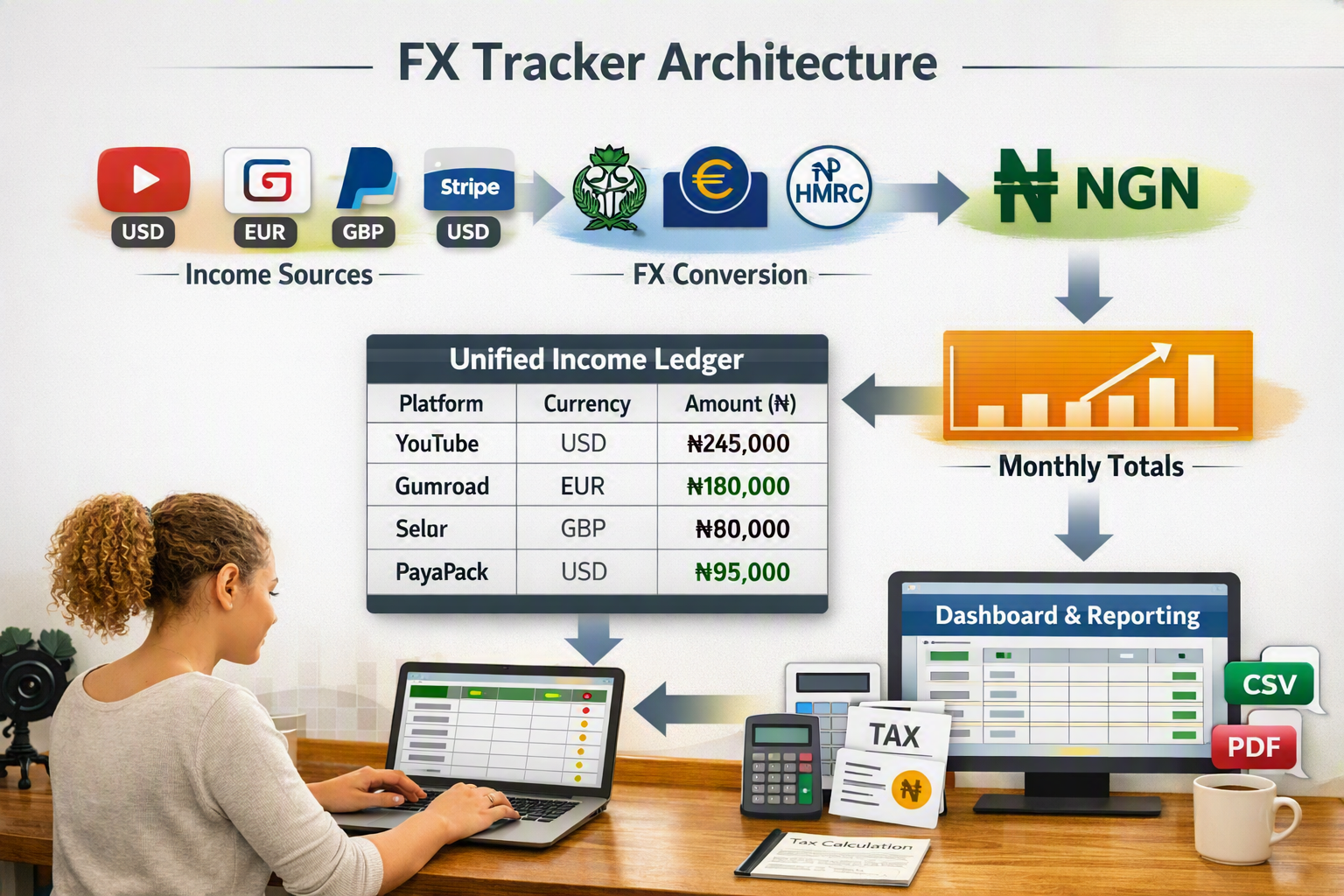
Nigerian residents are taxed on worldwide income, so USD, GBP and EUR earnings from foreign platforms are within scope. The official basis is the CBN rate, but almost nobody actually receives it — banks and processors convert at their own. What matters most in practice is recording the foreign amount, the date, the rate you were given and the naira you received, consistently, so any figure you report is one you can explain.
Dollar Income in Nigeria: What the Naira Figure Actually Is
A Lagos developer invoices a US client for $4,000. Payoneer takes its cut. The money lands in naira at whatever rate Payoneer applied that morning. Meanwhile the Central Bank of Nigeria published an official rate for the same day, and the parallel market had a third number.
Three rates, one payment. Which one is your income?
This is the question nobody answers properly for Nigerian platform earners, and it matters more here than almost anywhere else — because the gaps between those rates are not rounding errors. They are a meaningful share of what you earned.
Start with the part that is not in doubt
Individuals resident in Nigeria are taxed on their worldwide income.
Not on what you bring into Nigeria. Not on the naira portion. On all of it. The client being foreign, the platform being foreign, the money sitting in Payoneer or a domiciliary account, the payment never touching a Nigerian bank — none of that changes the position.
This is the single most misunderstood point among Nigerian freelancers and creators, and it is the one that turns into a real problem later, because platforms increasingly report earnings to tax authorities and the figures do not have to match your bank statements to be a problem.
Where income has genuinely been taxed abroad, relief may be available against your Nigerian liability. That is a different thing from the income not being taxable, and claiming it requires records of the foreign tax.
Which rate, and what to record
The official basis is the CBN rate. The Central Bank publishes an official daily rate.
Most Nigerian earners never receive it. Your bank, Payoneer, Wise, Grey and Lemfi each convert at their own rate, and the parallel market is a different number again.
Record what happened. For every foreign payment:
- the foreign amount
- the date received
- the rate used, and by whom
- the naira you received
- the fees taken, separately from the rate
That is the whole habit. A figure with a date and a rate behind it is one you can explain. A figure rebuilt from a bank statement months later is not.
If the basis you use differs from the official one, ask a qualified Nigerian adviser once and settle it.
The gap is a business cost, and most people never count it
Take a $4,000 payment, purely as an illustration of the shape rather than a claim about any provider's pricing.
The platform takes its fee first — say 10% on a marketplace contract — leaving $3,600. The processor takes a transfer or conversion fee. Then the conversion happens at the processor's rate rather than the official one, and the difference between the two, on a spread of a few per cent, is another slice.
By the time naira reaches your account, three separate deductions have happened, and only the first one appears anywhere you would naturally look. Most earners see the final naira figure, compare it to $4,000 in their head at whatever rate they remember, and conclude vaguely that "the dollar rate was bad this month."
The fee was recorded nowhere. The spread was recorded nowhere. Both are real costs of earning the money, and the fee at least is generally deductible — but you cannot claim what you never wrote down.
Our currency take-home calculator works this through for a single payment, and the take-home pay calculator works backwards from a payout to the gross behind it if all you have is what landed.
Where the money arrives from matters too
Nigerian platform earners rarely have one payment route. A typical freelancer might have Upwork paying to a domiciliary account, a direct client sending via Wise, a small YouTube AdSense payment arriving monthly, and a Nigerian client paying in naira with withholding tax deducted at source.
That is four routes, three currencies, four different fee structures and four different conversion behaviours — and one tax position that has to reconcile all of them.
The failure mode is not laziness. It is that no single statement shows the whole picture, so the only way to see it is to assemble it deliberately, as the year runs. The income tracker exists for exactly this: gross, fees and net held separately across 145+ platforms and 50+ currencies, with the conversion basis recorded rather than assumed.
Domiciliary accounts do not park the problem
A common assumption is that leaving earnings in USD — in a domiciliary account, in Payoneer, offshore — defers or avoids the Nigerian position until you convert.
It does not. Tax follows the income, not the account. If you are resident, the income is within scope when it arises, and a naira value still has to be established for it. Choosing when to convert is a treasury decision, and often a sensible one given how the naira has moved. It is not a tax decision, and treating it as one is how people end up with a year of earnings they cannot value.
Withholding tax, where a Nigerian client is involved
Where a Nigerian company pays you, withholding tax may be deducted at source. That is not a cost — it is tax already paid on your behalf, and it should be credited against what you owe.
Keep the credit notes. This is one of the few places where paperwork you did not create is worth real money to you, and it is routinely lost.
What to do
If you take one thing from this page, make it a habit rather than a rule.
Record every foreign payment at the moment it arrives — amount, currency, date, rate applied, naira received, fees deducted. Five fields. Two minutes. It is the difference between a tax position you can defend and a number you are guessing at.
Then work out what you actually kept. Take last quarter, add up your gross across every platform in the original currency, apply the rates you were actually given, subtract the fees, and compare it to what you thought you earned. Most Nigerian platform earners find the gap is larger than they expected — and that a good part of it was deductible all along.
To be clear about the boundary: PlatformTaxHub organises and estimates. It does not file returns, and it is not a substitute for a qualified Nigerian tax adviser — particularly on the conversion basis question, which is genuinely one for a professional. For the broader Nigerian position, our Nigeria platform income tax guide covers what changed on 1 January 2026.
Frequently Asked Questions
Work this out for yourself
Mason
FCCA FellowFounder, PlatformTaxHub | Author of the Platform Transparency Series
I help multi-platform earners find the income their dashboards are hiding — and keep more of what they actually make. Fellow of Certified Accountants and former Finance Transformation specialist with decades of experience across FTSE 250 and global organisations. PlatformTaxHub was built after experiencing the platform income problem firsthand and seeing what tax authorities have planned for the earners who aren't ready.
👉 Get your free Platform Earnings Health Check