Table of Contents
- Each app tells you the truth about itself and nothing else
- The miles between the apps belong to nobody
- What a multi-apping week looks like
- Two payout schedules make the month unreadable
- Why the question "which one pays better" has no answer
- What to track instead
- The figure that matters
- Frequently Asked Questions
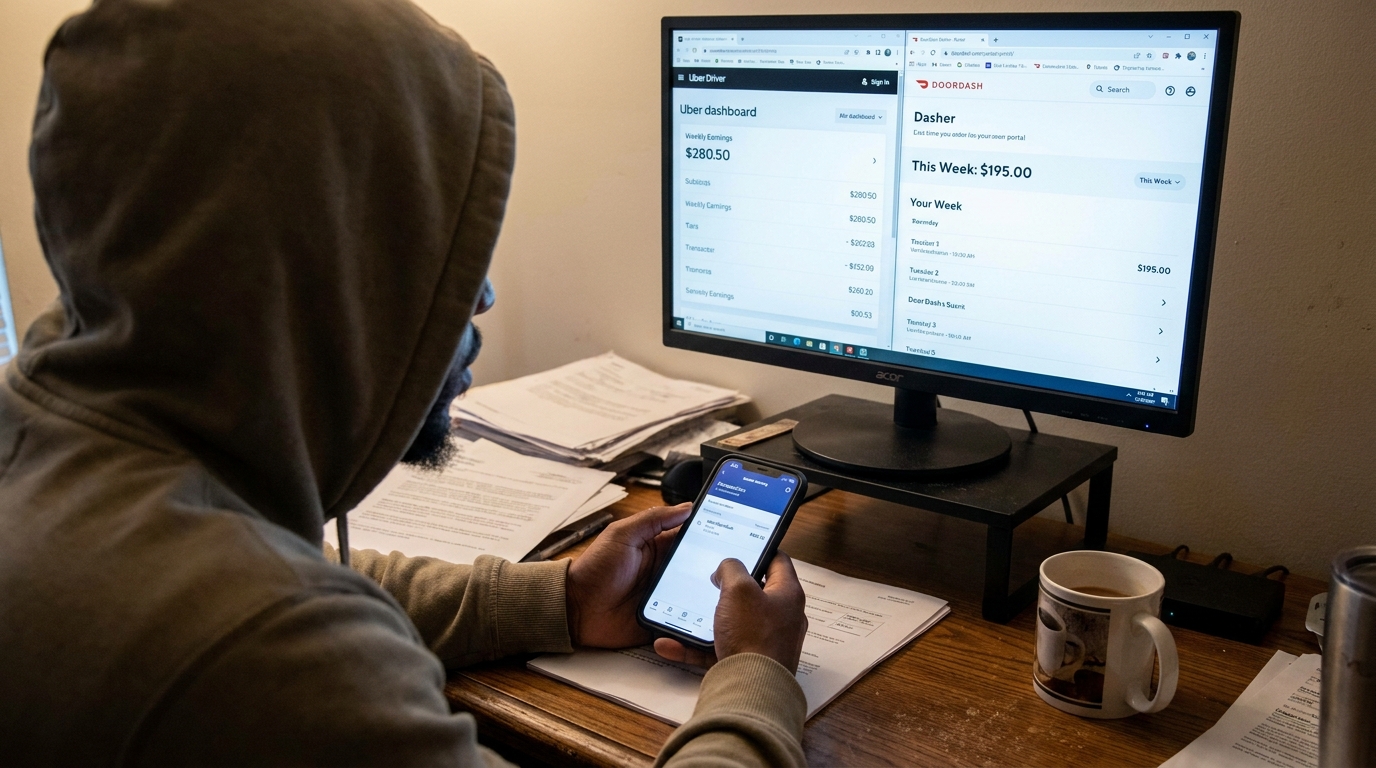
Multi-apping Uber and DoorDash leaves you with two separate earnings screens, two payout schedules and one set of miles that belongs to both. Neither app knows the other exists, so neither can tell you your real hourly rate. What you keep is total gross from both, minus each platform's cut, minus the running cost of the vehicle across every mile, minus what you owe on the profit. The only figure that matters is the one neither dashboard shows you.
Multi-Apping Uber and DoorDash: What You Actually Keep
Platform fees change without notice. The fee figures in this article were checked in September 2026 and are used as worked examples, not as current rates. For what a platform charges today, see Uber and DoorDash.
Tax rates and thresholds change every tax year. The 2026 US figures here were checked in September 2026; for the current position see IRS self-employment tax. General information, not advice on your own return.
Most delivery drivers run both apps. Gridwise reports that more than 60% of active Uber Eats drivers also use DoorDash, so this is the normal way the work is done rather than an edge case.
It is also how you end up with two earnings screens, two payout schedules and one vehicle underneath both.
Neither screen is wrong. Both are incomplete in the same way, and the gap between them is where your real result lives.
Each app tells you the truth about itself and nothing else
Open the Uber app and it shows what Uber paid you. Open DoorDash and it shows what DoorDash paid you. Both are accurate. Neither is your income.
The first reason is the obvious one: each platform takes a cut before the number reaches you, and each calculates that cut differently. The second reason is the one that costs more. Your car does not know which app was open. It burns the same fuel, wears the same tyres and depreciates at the same rate whether the trip was a ride or a burrito.
So you have two revenue figures that are cleanly separated and one cost base that is not separated at all. Any attempt to work out whether the week was good has to put those back together, and neither app will do it for you.
The miles between the apps belong to nobody
This is the specific thing that multi-app drivers lose, and it is worth naming precisely.
You drop a passenger at the far side of town. You open the other app. You accept a delivery pickup two miles away. Those two miles are business miles. You were working. You were travelling between one job and the next.
But the ride ended when the passenger got out, and the delivery started when you accepted it. In Uber's records those miles do not exist. In DoorDash's records they do not exist either. If your mileage log is whatever the apps report, you have just worked two miles for free and paid tax on the privilege.
Across a full week of switching between apps, this is not a rounding error. It is the difference between a deduction that reflects your actual driving and one that reflects only the portions of it that a platform happened to be watching.
What a multi-apping week looks like
Round numbers, for the shape rather than the amounts. Say a week produces $600 from Uber and $400 from DoorDash after each platform's cut, on 500 miles driven in total.
The gross-looking figure is $1,000. The figure most drivers carry in their head is $1,000. But the vehicle ran 500 miles, and running cost is real money whether or not it left your account this week. At a cost somewhere in the range most drivers face for fuel, maintenance, insurance and depreciation, several hundred dollars of that $1,000 has already been spent. What remains is profit, and it is profit that gets taxed, not the $1,000.
Run those numbers for your own week in the Uber take-home calculator, then run the miles through the mileage deduction calculator and the DoorDash version. The gap between what the apps showed you and what the calculators show is the number this article is about.
Two payout schedules make the month unreadable
Uber and DoorDash pay on different rhythms, and both offer instant transfer for a fee. A driver using instant pay on one and the standard schedule on the other will see money arrive in a pattern that matches neither week's work.
This matters beyond tidiness. When someone asks what you earn a month, or when you ask yourself whether to keep driving, the answer is being drawn from a bank balance that is a blend of two schedules, minus transfer fees, plus whatever arrived late from the week before. It is not a monthly income figure. It is a cash flow artefact.
The payout calendar shows when each platform actually pays, which is the first step to reading a month rather than guessing at it.
Why the question "which one pays better" has no answer
Drivers ask this constantly and the honest response is that it depends on a comparison nobody is set up to make.
Uber pays per trip. DoorDash pays per delivery. Neither pays per mile, which is the unit your costs are measured in. A ride that pays more than a delivery can still be worth less if it covers more distance, involves more waiting, or ends somewhere you cannot pick up again.
To answer it for your market and your hours you need both platforms measured against the same cost base and the same mileage log. That is a single calculation across two platforms, and it is exactly the calculation that two separate apps make impossible.
What to track instead
Stop treating the two apps as two jobs. Treat them as one business with two revenue streams.
That means one mileage log covering every business mile, including the ones between apps. It means recording each platform's gross and its fee separately, because the fee is a deductible cost and losing it inside a net figure means paying tax on money you never had. And it means one running total, so the question "how did this week go" has an answer that does not depend on which app you happen to be looking at.
None of this requires more admin than you are already doing. It requires doing it in one place rather than two.
The figure that matters
Your income is not what Uber paid you. It is not what DoorDash paid you. It is not the two added together either, because that number has not met your costs yet.
It is what is left when both platforms have taken their cut, the vehicle has been paid for across every mile, and what you owe on the profit has been set aside. That figure exists. It is just that no app you use is built to show it to you, because each of them can only see its own half.
Frequently Asked Questions
Work this out for yourself
Mason
FCCA FellowFounder, PlatformTaxHub | Author of the Platform Transparency Series
I help multi-platform earners find the income their dashboards are hiding — and keep more of what they actually make. Fellow of Certified Accountants and former Finance Transformation specialist with decades of experience across FTSE 250 and global organisations. PlatformTaxHub was built after experiencing the platform income problem firsthand and seeing what tax authorities have planned for the earners who aren't ready.
👉 Get your free Platform Earnings Health Check