Table of Contents
- 1. Identity Is No Longer Simple
- 2. Friction Is a Tax You Don't See
- 3. The Trust Trade Has to Be Fair
- 4. Why I Would Say Yes to Stripe and No to LinkedIn
- 5. Who's Actually Processing Your ID?
- 6. LinkedIn Is Confusing Control with Safety
- 7. The Tracking You Don't See
- 8. Public Identity vs Legal Identity
- 9. "But I Already Give My ID Everywhere"
- 10. The Privacy Paradox
- 11. The Winners of 2026 Will Design for Respect
- 12. The Losers Will Add Friction Without Value
- Final Thought
- Conclusion
- Frequently Asked Questions
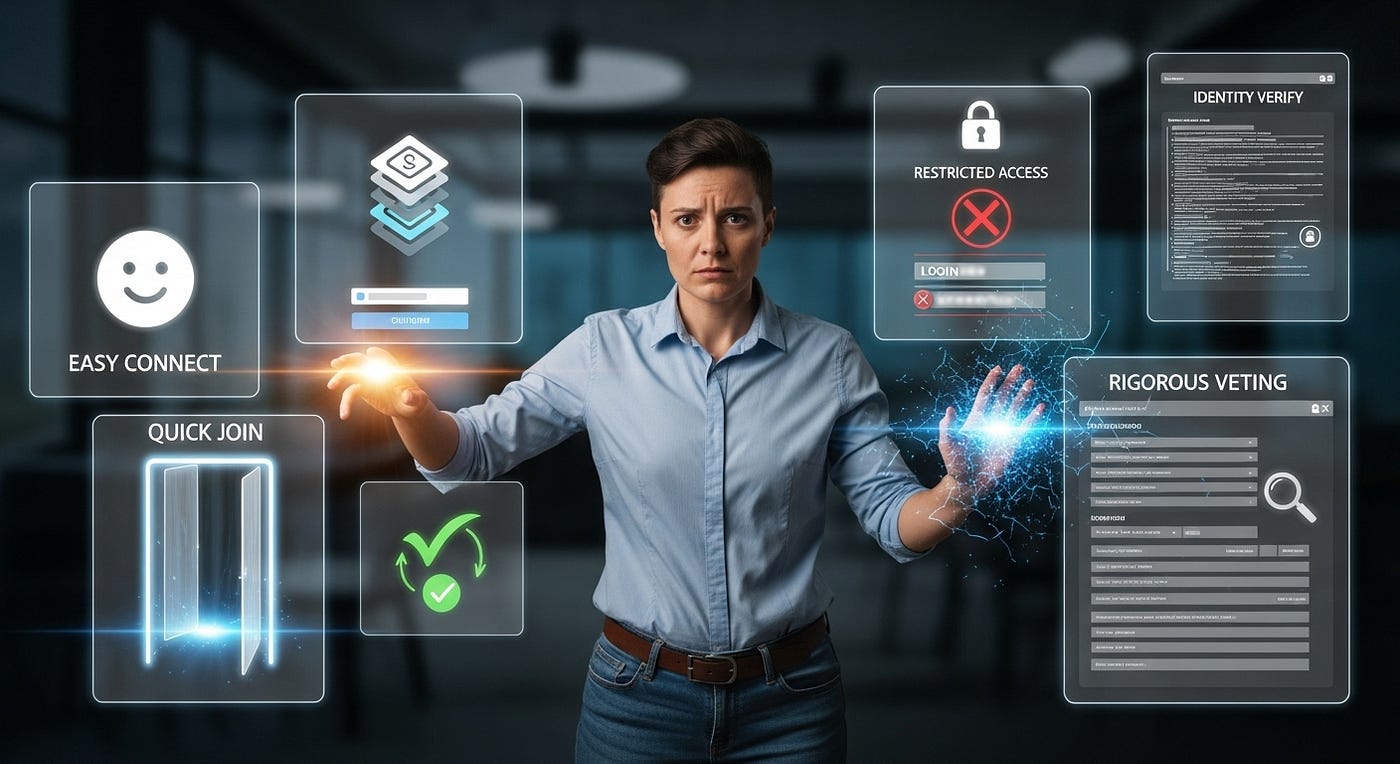
ID verification on platforms that do not pay you or process your transactions is not "safety"—it is extraction. In 2026, the "Trust Trade" requires a fair exchange of value. If a platform asks for sensitive data without providing a corresponding benefit, it is adding an "Identity Tax" that stifles new voices.
The Platform Friction Crisis
Who's really processing your ID, and have you thought about where this leads?
Digital identity in 2026: are we building lives, or just managing platform access?
⚡ The 30-Second Summary:
- The Problem: Platforms are demanding government IDs without offering a fair value exchange (the "Trust Trade").
- The Risk: Handing sensitive data to third-party processors creates massive "Identity Friction" and long-term security risks.
- The Solution: Designing platforms for respect, not just compliance.
Everywhere I turned while launching my brand, the advice was the same.
Get on LinkedIn to build your authority.
Build a presence.
Post content.
Be visible.
No offence Medium. Don't take it personal.
So I tried. LinkedIn's response? Verify your ID.
And I said NO.
Not because I have anything to hide. Not because I'm anti-rules. But because something about it felt… wrong. Felt intrusive.
And the more I thought about it, the more I realised, this isn't just about LinkedIn. It's about platform friction.
And in 2026, friction is going to decide which platforms win and which ones quietly fade.
1. Identity Is No Longer Simple
Most platforms still think identity works like this: legal name = real person = trust.
But that model belongs to the 20th century. In the modern digital economy:
- Your government name is not always your public name.
- Your public name is not always your brand.
- Your brand is not always your legal entity.
Creators. Founders. Writers. Educators.
We don't build trust with passports.
We build trust with:
- Voice and authenticity
- Consistency
- Ideas and impact
- Brand identity
So when a platform says: "Before we let you speak on our platform, show us your documents," it's not just misunderstanding how identity works — it's putting in a point of friction.
2. Friction Is a Tax You Don't See
ID verification is sold as safety. Age verification became a thing recently. But this is experienced by users as extra steps, extra risk, extra exposure, extra loss of control.
And every extra step is a tax on participation. Not a money tax, but a cognitive one.
People don't say: "I refuse to verify." They say: "I'll do it later," or "How do I know who holds my data?"
And this "later" becomes never getting round to it — or finding a platform that has less friction. That's how platforms bleed users: not with explosions, but with silence.
Note: If the friction of "not knowing where you stand" could be a problem, try our free Platform Earnings Health Check — no ID required.
3. The Trust Trade Has to Be Fair
Here's the part that some of these platforms miss: verification is not neutral. It's a demand.
So the real question isn't: "Can you verify?" It's: "Do I trust you enough to give you my identity?"
If YouTube asked for verification, and I say why? It's because they are a social platform that pays you and protection is necessary. Your brand identity can be separate because your identification can match your bank account. You earn through their platform. So there is an upside. That's a fair trade.
LinkedIn asks for my identity, and I say why? Because LinkedIn is first and foremost a jobs platform. A middleman. LinkedIn doesn't pay me. So the exchange is fraught with friction. That's not a deal. That's extraction.
4. Why I Would Say Yes to Stripe and No to LinkedIn
Stripe asks for ID verification. I comply without hesitation. Why? Because Stripe processes my payments. They're liable for fraud. They pay me directly. The exchange is fair.
YouTube asks for ID for monetization. Makes sense. They're paying me. They need to verify who gets the money. That's reasonable friction.
But LinkedIn? They're not paying me. They're not processing transactions for me. They're a networking platform that profits from my content, my connections, my presence.
When they ask for my ID to "verify" my brand account, they're asking me to take on risk — exposing my government documents — without any corresponding benefit to me.
That's not verification. That's extraction.
5. Who's Actually Processing Your ID?
Here's what most people don't ask: when you hand over your government ID, who actually sees it?
In the EU, platforms have legal obligations. They must tell you:
- How your data will be processed
- Where it will be stored
- How long they'll keep it
- Who has access to it
And if financial transactions are involved, the rules get stricter.
But LinkedIn's ID verification is processed by a third party. That third party can be:
- Sold to another company
- Acquired by a competitor
- Subject to different privacy laws
- Controlled by entities or jurisdictions you've never heard of
Remember when TikTok's data handling became a national security issue? Remember when companies you trusted got acquired and suddenly your data was somewhere else?
This isn't conspiracy. This is how platforms work. They outsource. They partner. They pivot.
And your government ID — the one document that can't be changed if it's compromised — is now in a chain of custody you don't control.
So when LinkedIn says "we need your ID for verification," the real question is: who is "we"? And what happens when "we" becomes "them"?
6. LinkedIn Is Confusing Control with Safety
The narrative is: become a member, "we're doing this for your protection."
But in practice, they have not shared how their verification systems stop bots, stop spam, stop scams, stop fake job listings.
What they might stop: new voices, small brands, independent thinkers, people who don't fit neat boxes.
All this brings us to the deeper problem: the gap between public identity and legal identity.
7. The Tracking You Don't See
"But the government already tracks you," you may think. True. Through tax filings, bank transactions, official documents, legal records.
That's expected tracking. That's the social contract. You pay taxes, the government needs to know who you are.
But a middleman? A job portal? A networking platform?
They're not the government. They're not your bank. They're not processing your income. They're the gateway between you and a potential employer, you and a potential client, you and your professional network.
They facilitate. They don't transact.
So why do they need the same level of identity verification as entities that actually handle your money or your legal status?
The answer is: they don't. Unless the goal isn't verification. Unless the goal is data.
Your government ID links everything — your legal name, your date of birth, your address, your photo, your ID number. Once a platform has that, they can cross-reference it with other databases, build a more complete profile, track you across platforms, and sell more targeted data to advertisers.
I'm not saying that's definitely what's happening. I'm saying that if a platform doesn't pay you, doesn't process transactions for you, and doesn't have legal liability for your actions, why do they need your government ID? What's the real reason?
8. Public Identity vs Legal Identity
Here's the reality no one talks about: people don't want to live online as paperwork.
They want to live as their ideas, their voice, their work.
Most people want to live their lives with a layer of protection — similar to using an LLC or Ltd company instead of a personal name.
The best platforms in 2026 will understand this distinction:
- Legal identity belongs in the compliance layer.
- Public identity / brand identity belongs in the human layer.
The compliance layer is where the paperwork genuinely does belong — a lender or a landlord asking a platform earner to evidence their income is a fair trade, and what that evidence actually needs to look like is a different question from handing a social network a passport scan.
When you collapse those into one thing, you create hesitation, distance, quiet quitting / silence.
And silence kills community.
9. "But I Already Give My ID Everywhere"
I know what some of you are thinking. I've already given my ID to my bank, my employer, airlines when I travel, rental agencies, age verification sites, a dozen other places. So what's the big deal?
Fair question. Here's the difference. Those entities either:
- Have a legal obligation to verify you — banks, employers, government services, or
- Are directly providing you with a service that requires identity proof — airlines, rentals
The trade is clear.
But social media platforms? Networking sites? Content platforms where you're not even earning money? That's different.
And here's what most people don't think about: the long-term impact.
Every time you give your ID to another platform, you're:
- Expanding the attack surface — more places for your data to leak
- Increasing the number of third parties with access
- Creating more connections between your digital identities and your legal identity
- Trusting more companies to protect your most sensitive document
One breach at one third-party processor could expose IDs from multiple platforms. One acquisition or company pivot could move your data to a jurisdiction with weaker privacy laws. One policy change could turn verification data into a monetization opportunity.
You might not see this as a problem today. But as more platforms demand ID, more third parties process it, more data breaches happen and more governments tighten surveillance, you'll wish you'd been more selective about who you trusted with your government identity.
The question isn't "do I see this as an issue?" The question is: have I thought about where this leads?
10. The Privacy Paradox
Here's the irony. We're told to:
- Use strong passwords
- Enable two-factor authentication
- Turn off data tracking in apps
- Limit what we share online
- Use VPNs
- Disable cookies
And recently, we're told to turn off privacy settings so AI doesn't train on our content. We're taking back control over our digital footprint.
So why are we simultaneously being asked to hand over the one document that connects our entire digital life to our legal identity?
On one hand: protect your privacy, don't let platforms track you. On the other: give us your government ID or you can't use our platform.
You can't have both.
If we're serious about privacy, if we're serious about controlling our data, then maybe the answer isn't compliance. Maybe the answer is quietly exiting platforms that demand more than they deserve.
No angry posts. No dramatic announcements. Just: stop using platforms that don't respect the trade. That's what I'm doing with LinkedIn.
Not because I'm anti-platform, but because I'm pro fair trade and pro less platform friction. And sometimes the most powerful statement you can make is absence.
11. The Winners of 2026 Will Design for Respect
The platforms that win the next phase won't just be smarter. They'll be kinder. Accommodating.
They'll:
- Reduce unnecessary steps
- Ask only for what they truly need
- Earn trust before demanding proof
- Let people exist as brands, not just documents
They'll understand this: people don't join platforms. They build lives on them.
12. The Losers Will Add Friction Without Value
The losing platforms will add more forms, add more gates, add more rules, add more control.
And then wonder why growth slows, engagement drops, loyalty disappears.
Not because users hate rules. But because they hate pointless ones.
Final Thought
The future of platforms isn't about verification. It's about permission.
In 2026, users won't ask: "What can this platform do?" They'll ask: "What does this platform respect?"
And the answer to that will decide everything.
Conclusion
If you've been asked to verify your identity on a platform and felt resistance, hesitation, or even anger — you're not alone.
That instinct is worth listening to. It isn't paranoia. It's a reasonable reading of an unfair trade.
A platform that pays you, processes your money, or carries legal liability for what you do has earned the right to ask. A platform that does none of those things is asking you to carry the risk for its benefit.
So the question is not whether you have something to hide. It's which platforms have earned the one document you can never change.
P.S. Stop the Friction in Your Own Finances
I'm building PlatformTaxHub to solve the same friction I wrote about today — specifically the nightmare of tracking multi-platform, multi-currency earnings. If you're tired of the spreadsheet chaos, tracking income volatility, or underestimating your taxes, use our resources to take back control:
- Track Your Income: See what's actually hitting your pocket with the Income Tracker.
- Extrapolate Your Net Profit: Normalise irregular independent-worker income with Net Profit & Financial Insights.
- Know Where You Stand Before You File: The Tax & Compliance Suite produces a tax estimate and a filing-readiness checklist so you go into your return prepared. It does not file anything for you.
- Scale Your Brand/Business: Use the Platform AI Growth Engine to personalise your earnings growth.
Don't let platforms treat you like paperwork. Start treating your platform work like a business.
Frequently Asked Questions
Work this out for yourself
Mason
FCCA FellowFounder, PlatformTaxHub | Author of the Platform Transparency Series
I help multi-platform earners find the income their dashboards are hiding — and keep more of what they actually make. Fellow of Certified Accountants and former Finance Transformation specialist with decades of experience across FTSE 250 and global organisations. PlatformTaxHub was built after experiencing the platform income problem firsthand and seeing what tax authorities have planned for the earners who aren't ready.
👉 Get your free Platform Earnings Health Check