Table of Contents
The platform economy spans 435 million earners across gig, freelance, creator, ecommerce, sharing, and digital categories. The gig economy alone exceeds $674 billion. DAC7, OECD reporting rules, and the 1099-K framework are closing the visibility gap on all of it.
The 2026 Platform Earners Economy Index: Market Size, Earnings & Six Economies
Platform fees change without notice. The fee figures below were checked in September 2026 and are used as worked examples, not as current rates. For what a platform charges today, see YouTube, Patreon, Airbnb, Etsy, Amazon.
As of June 2026, here is how the platform economy is sized and structured: approximately 435 million people worldwide earn income through digital platforms spanning gig work, freelancing, content creation, ecommerce, asset sharing, and direct digital commerce. The combined value of these economies is already in the high hundreds of billions of dollars, with credible forecasts pointing to multi-trillion-dollar scale before the end of the decade.
This index maps each of the six platform economies — their typical roles, income models, and earnings ranges — alongside the market size data, fee structures, and regulatory shifts that are reshaping compliance for everyone in them.
What is a platform earner?
A platform earner is anyone who makes money through an online platform that sits between them and their customer or audience. That includes drivers and couriers using apps like Uber, freelancers on Upwork, creators on YouTube, indie sellers on Etsy or Amazon, hosts on Airbnb, and professionals billing through digital service platforms.
Most global labour statistics do not track these people as one group. Separate counts exist for gig workers, freelancers, creators, ecommerce sellers, and self-employed workers. Research synthesised by the World Economic Forum and the ILO estimates that between 154 million and 435 million people worldwide engage in online gig work alone, depending on whether occasional or regular platform users are counted. When creators, hosts, marketplace sellers, and professionals are added, 435 million is a reasonable and conservative anchor for the full platform earner population.
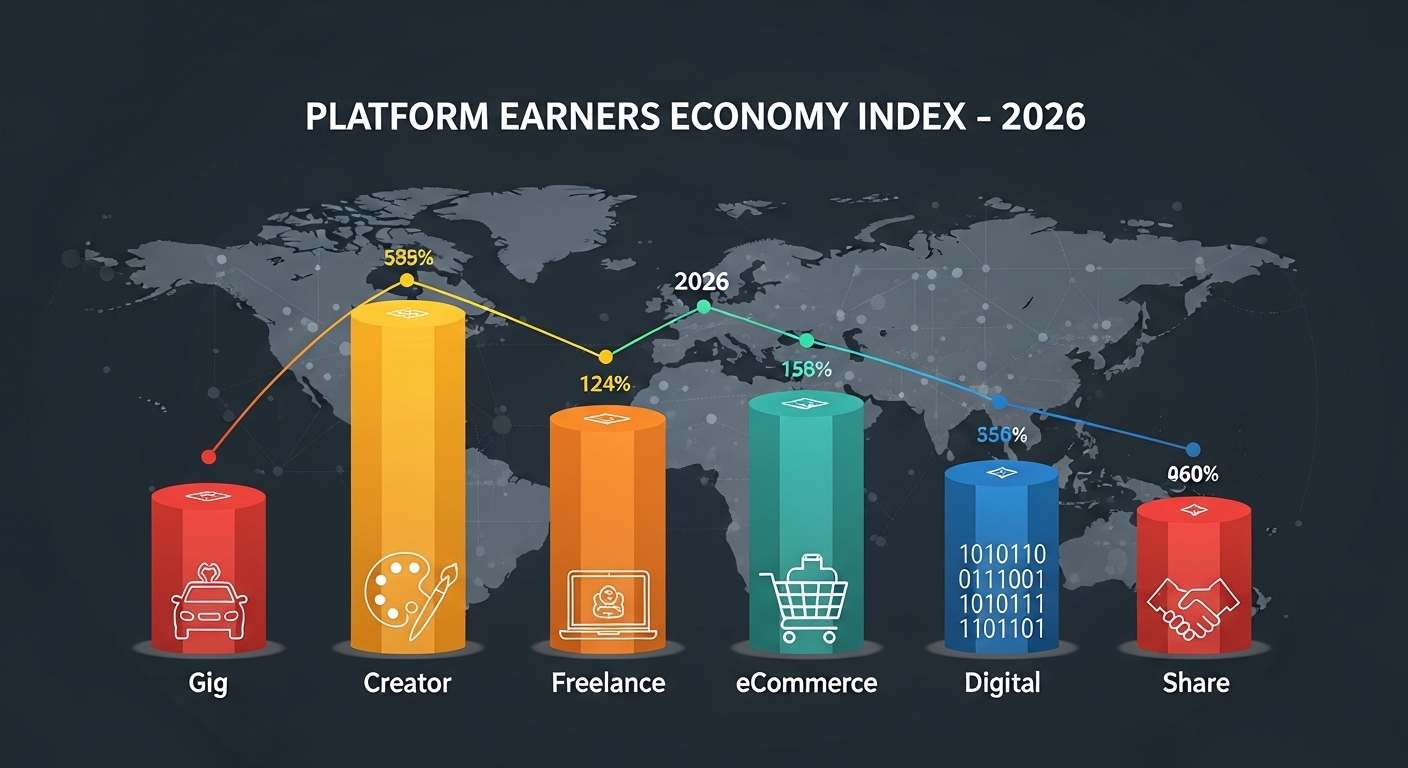
The six platform economies
These six economies are overlapping circles, not mutually exclusive categories. A single person might drive for Uber (gig), sell presets on Etsy (ecommerce), run a YouTube channel (creator), and invoice clients via Stripe (digital) in the same year.
| Economy | Typical roles | Main income model | Example platforms |
|---|---|---|---|
| Gig | Drivers, couriers, taskers | Per trip / task | Uber, DoorDash, Instacart, TaskRabbit |
| Freelance | Developers, designers, consultants | Project / hourly retainers | Upwork, Fiverr, Toptal, Preply |
| Creator | Video, audio, writers, artists | Ads, subscriptions, sponsors, merch | YouTube, TikTok, Patreon, Substack |
| Ecommerce | Indie sellers, micro-brands | Product sales, print-on-demand | Amazon 3P, Etsy, Mercado Libre, Shopify |
| Share | Hosts, car sharers, space owners | Asset rental / bookings | Airbnb, Vrbo, Turo, Peerspace |
| Digital | Direct billing, online services | Invoices, digital products | Stripe, PayPal, Paddle, Gumroad |
This taxonomy matters because regulation, earnings patterns, and tax pain points differ sharply between a rideshare driver and a newsletter writer — even though both are platform workers.
How big is the platform earners economy?
Global workforce
There is no single official count of platform earners, but the data triangulates to a clear picture:
- Research cited by the European Commission reports that over 28 million people engaged in platform work in the EU in 2022, with projections of 43 million by 2025.
- Globally, freelancers and self-employed workers now represent around 46–47% of the workforce — approximately 1.57 billion people — many of whom rely on platforms for at least some of their income, according to research compiled by HRStacks.
- In the US alone, the independent workforce exceeds 70 million people, with the independent economy contributing over $1 trillion annually, per analysis from Carry.
Market size by economy
Gig economy: Business Research Insights estimates the global gig economy at $674.13 billion in 2026, with forecasts to $2.52 trillion by 2035 at a 15.79% CAGR. A separate synthesis by Carry notes that gig work engages approximately 12% of the global labour force.
Freelance economy: Freelance platform revenues reached $5.6 billion in 2024 and are projected to reach $13.8–$16.5 billion by 2030, per data compiled by The Interview Guys. The freelance workforce itself — including those who work outside digital platforms — is estimated at 1.57 billion globally.
Creator economy: Precedence Research values the global creator economy at $254.4 billion in 2025, rising to $313.95 billion in 2026 and projected to reach $2.08 trillion by 2035 at a 23.41% CAGR. A separate analysis on LinkedIn puts the 2024 figure at $212.32 billion with a path to $894.84 billion by 2032. The US creator economy alone is estimated at $66.78 billion in 2025.
Ecommerce (marketplace sellers): Global ecommerce marketplace GMV spans Amazon, Alibaba, Mercado Libre, Shopee, Lazada, Jumia, Etsy, and dozens of regional platforms. Mercado Libre processed tens of billions in GMV in 2025 with double-digit growth, per Gab Growth, underscoring the importance of Latin American marketplaces for independent sellers alongside the dominant US and Asian platforms.
Share economy: The asset-sharing segment — accommodation, transport, and space — is grouped within gig economy forecasts in most market studies. Airbnb's 2025 filings highlighted continued growth in gross booking value and host earnings, even as margins fluctuated, per Stock Titan.
Digital economy: Stripe, PayPal, Square, Wise, and Payoneer collectively process trillions of dollars annually, a portion flowing directly to sole traders, freelancers, and creators. Tax technology providers including Sovos note that the shift toward real-time digital reporting is pushing more of these flows into the view of tax authorities.
The combined platform earners economy is comfortably in the high hundreds of billions today, with credible paths to multi-trillion-dollar scale by the early 2030s.
What do platform earners actually make?
Macro market size is impressive. What most earners care about is what someone in their position actually earns. The data offers broad directional ranges rather than precision.
Gig workers (rideshare, delivery): Analyses of driver and courier earnings show gross hourly earnings of $20–$30 in high-income markets before expenses, with net earnings materially lower after vehicle costs, waiting time, and platform commissions. Many gig workers treat platform work as supplementary income, per data from Carry.
Freelancers (development, design, writing, consulting): Freelance market analyses report average hourly rates of $20–$50 for online freelancers, with technical and specialised roles at the higher end, per comparison data from Best Job Search Apps. Freelancers maintaining full-time hours with consistent clients can reach median incomes comparable to or above traditional employment.
Creators (video, audio, written): The creator economy is heavily skewed. A small percentage of creators capture the majority of revenue while a long tail earns modest monthly amounts. With a $254.4 billion global market in 2025, even a fractional distribution translates to millions of people earning some income from YouTube, TikTok, Patreon, Substack, and similar platforms.
Ecommerce sellers: Top sellers reach six- or seven-figure annual gross sales. Most individual marketplace sellers earn considerably less, though published distributions vary widely by marketplace and we have not found a figure we can stand behind. Profit margins are often compressed by fees, advertising, and inventory costs.
Share economy hosts: Airbnb's filings show rising gross booking value and host earnings. Most hosts use income as a supplement to primary earnings; a smaller professional host cohort generates substantial revenue.
A consistent theme: income is highly skewed, multi-platform, and volatile — which makes tracking, tax compliance, and financial planning fundamentally harder than in traditional employment, per IRS research on platform gig work evolution.
Primary vs side income
In some markets, over half of freelancers and gig workers use platform work as their primary income source; the rest use it to top up wages or fund specific goals. Approximately 43% of freelancers live in cities, where client density and platform access are highest. Side-gig earners are particularly at risk of under-reporting — they often treat small intermittent payouts differently from a main job, even though tax systems make no such distinction, per a 2024 study published on PubMed Central.
How much do platform fees actually cost earners?
Gross platform revenue says little about what reaches a bank account. Three main layers reduce take-home pay before tax: platform fees, payment processor fees, and operational costs.
Freelance platforms: Upwork charged a variable service fee of 0–15% per contract as at September 2026, having replaced a tiered 5–20% structure in May 2025. Fiverr takes a flat 20% commission. Payment processors add a further 2–4% for card transactions and currency conversion, per data from Best Job Search Apps.
Creator platforms: Patreon charges approximately 10% for most creators plus payment processing, leaving creators with roughly 85–88% of gross subscriber payments before tax. YouTube retains 45% of ad revenue and pays creators 55%, with additional cuts on memberships and Super Chats depending on region.
Gig and share platforms: Rideshare and delivery platforms take 20–30%+ in commissions on fares and orders. Airbnb's host-only fee model charges approximately 15% in many markets.
Ecommerce marketplaces: Amazon referral fees range from 8–15% plus fulfilment charges. Etsy's transaction and listing fees add up to approximately 6.5% before payment processing and advertising.
In realistic multi-fee scenarios, platform and payment fees remove 15–35% of gross receipts before operational costs and income tax. These fees are generally deductible business expenses — but only when tracked consistently with the correct gross-income-first methodology.
Tax rules are catching up to platforms
For years, platform work grew faster than tax and reporting infrastructure. That gap is closing systematically.
Global reporting frameworks
DAC7 (EU): The EU's DAC7 directive requires digital platforms to report income earned by sellers, hosts, and service providers to national tax authorities, with cross-border data sharing for international earners. This affects accommodation, personal services, product sales, and vehicle sharing. Many platform earners now have income pre-reported to tax authorities in ways that were previously invisible, per the Platform for Collaboration on Tax.
OECD Model Reporting Rules: The OECD's framework for digital platform reporting has been adopted by over 40 countries. The direction of travel is toward more granular and more frequent reporting, which raises detection risk for under-reported platform income across all categories. The rules themselves are the OECD's Model Reporting Rules for Digital Platforms, published by the OECD.
US 1099-K framework: The IRS has published research showing rapid growth in 1099-K and 1099-NEC reporting from platform gig work between 2012 and 2023. While implementation of a $600 threshold for many payment platforms has been delayed, the direction is toward more granular reporting of platform income across all categories.
Behavioural evidence on under-reporting
Research is consistent on one point: without third-party information reporting, non-compliance among self-employed and platform workers is substantial — because tax authorities have limited data to cross-reference. A 2024 study on PubMed Central found that providing clear information to platform workers about tax enforcement can reduce under-reporting, though it may also reduce platform participation when compliance costs feel disproportionate.
Many occasional earners treat platform income as "extra money" and do not systematically record it — missing deductions and creating surprise liabilities when under-reported income is later matched against platform reports.
What this means for platform earners in practice
The data tells a consistent story across every economy:
- Hundreds of millions of people earn platform income, spread across gig, freelance, creator, ecommerce, share, and digital categories
- The money flowing through platforms is in the high hundreds of billions globally, growing toward multi-trillion-dollar scale
- Individual earnings are fragmented, volatile, and fee-heavy — typically split across multiple platforms and payout rails with no consolidated view
- Tax and reporting regimes are tightening rapidly, increasing the stakes of under-reporting and incomplete record-keeping
The combination of scale, fragmentation, and regulatory pressure is what makes structured tracking — gross income, not deposits; official exchange rates; quarterly payment planning — a compliance necessity rather than an administrative preference.
For a structured approach to tracking income across all six economies, see Platform Tax Guide 2026. For how income distributes across earner tiers in practice, see Platform Income Calculator: How Much Do 4 Types of Online Earners Really Make.
Frequently Asked Questions
Work this out for yourself
Mason
FCCA FellowFounder, PlatformTaxHub | Author of the Platform Transparency Series
I help multi-platform earners find the income their dashboards are hiding — and keep more of what they actually make. Fellow of Certified Accountants and former Finance Transformation specialist with decades of experience across FTSE 250 and global organisations. PlatformTaxHub was built after experiencing the platform income problem firsthand and seeing what tax authorities have planned for the earners who aren't ready.
👉 Get your free Platform Earnings Health Check